Earlier this year, on October 14, we celebrated the 350th anniversary of the birth of WILLIAM PENN (1644-1718), undoubtedly the most famous of the early Quakers. Among his many achievements was the foundation of his utopian colony in America where people were allowed to worship without fear of persecution. Yet he also spent a large part of his life in Sussex, where he lived in a mansion house at Warminghurst near the village of Thakeham. Until the establishment of proper Quaker Meeting Houses, Friends would assemble at other members’ homes, and after their arrival at Warminghurst in 1676, the Penn household was also made available for this purpose. Warminghurst came into the area of the Horsham Monthly Meeting, and when Penn left England in 1682 for his first visit to America, he took with him many Quakers from the local area. In 1691 he helped to buy a property at Coolham, some four miles away, where the Thakeham Meeting House was established. Subsequently known as the ‘Blue Idol’, this famous building is still used to this day as a place of Quaker worship. It receives many visitors, often from the United States, who, among other things, come to savour the atmosphere so redolent of Penn’s era. Continue reading William Penn and the Quaker Linfields of Sussex→
In Longshot Vol 2 No 1 (May 1993), I wrote an article about CAREY HAMPTON BORRER, rector of Hurstpierpoint and amateur genealogist whose papers are now kept at the West Sussex Record Office. His research into the Lin(d)fields of Cuckfield and Hurstpierpoint led him to write a letter of enquiry to RALPH PARKINSON LINFIELD, a fellow clergyman, and vicar of St. Stephen’s, Elton, near Bury in Lancashire. Since his reply is preserved in the Borrer archive, I fully reproduced the contents which are of considerable interest, especially his claim that his grandfather was born in the Sussex village of Storrington and that as a boy he remembered visiting the churchyard and seeing the grave of his great grandfather. Unfortunately, Ralph gave no details of his immediate predecessors, but subsequent research has now revealed their identities and we are able to show exactly how he fits into the Storrington branch. Continue reading Ralph Parkinson Linfield: An Update→
The fascinating picture of HARRY LINFIELD of Sullington (#1394 in the database), was discovered by JOAN HAM in an album of old photographs. This album had been compiled by EMILY CAREW GIBSON of Sandgate during the 1870’s, and the photograph is reproduced here with the kind permission of the West Sussex Record Office (WSRO, Additional MS. 42,006). Continue reading Harry Linfield of Sullington→
The Protestation Returns of 1641/2 and the Hearth Tax records which start in 1662 are two of the most important sources to genealogists pursuing their enquiries into the 17th century, especially as many of the parish records are incomplete during the period of upheaval which followed the outbreak of the English Civil War. They both provide locational details of where families were living in a particular year, enabling the researcher to pinpoint the most likely parishes to search first in the quest for more information. Continue reading West Sussex Protestation Returns 1641/2→
In the last issue of Longshot, I promised to produce a list of all the Lin(d)field probate records which are kept at the West and East Sussex Record Offices. Well, here it is! I have endeavoured to compile an index of all the known wills, administrations and inventories relating to the county of Sussex, so I have also included the PCC records kept at the Public Record Office in Chancery Lane. Eventually, we will have copies of all these documents in the society archives; those we hold at present are marked with an asterisk, and I am slowly (perhaps I should say very slowly!) making transcripts of each and every one of them. There is a good chance that I may have missed out something completely, although my intention is to provide a comprehensive collection of everything available. Please get in touch if you know of any omissions. I should also mention that I am only dealing here with records up to 1858, before the Court of Probate Act established a Principal Probate Registry in London when all probate matters were removed from the jurisdiction of the Church. Continue reading Sussex Probate Records→
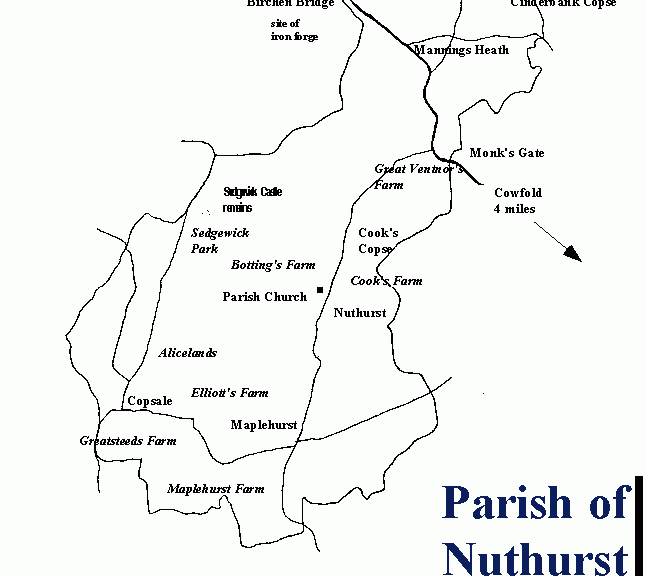
Among the many thousands of names we have now collected in the family archives, there are a number of individuals who stand out from the rest. One of these is undoubtedly Peter Linfield of Storrington. Born in 1734 in the parish of Nuthurst, Peter was the youngest son of William and Sarah Linfield, who were married at Itchingfield in 1724. His grandfather, Peter Linfield of Snow’s Farm in Nuthurst, was a successful yeoman farmer who died in 1715, leaving his estate to his eldest son, also Peter (1677-1756) who appears to have sold his inheritance some time before 1744. William Linfield, one of his five younger brothers, had to make do with the 40 shillings he received in his father’s will; nevertheless, it would appear he owned and farmed his own land because, with his brother Peter, he was qualified to vote in the General Election of 1734. Both of them travelled to Chichester to cast their vote, the qualification being the ownership of freehold lands or tenements whose annual net value was 40 shillings or more. Continue reading Peter Linfield of Storrington 1734-1791→
There cannot be too many among our readers who haven’t heard something of the legend of William Lindfield, who was entombed at Bramber Castle. It’s a chilling story, not unworthy of a place in the fiction of Edgar Allan Poe. I first came across it in the local guide, published by the village museum. (Ref. The History and Legend of Bramber Castle. Herbert E. Erredge; Bramber Museum) Despite his obvious embellishments, Erredge has produced an entertaining account of a particularly gruesome episode, and what follows is a summary of his narrative. Continue reading The Bramber Castle Legend→
Wills, administrations and inventories are valuable documents to family historians: they provide us with a glimpse of our ancestors not available in other records, of a nature which helps to bring them to life as people in their society and time. Wills not only help to clarify family relationships, but they usually give us information about occupation and property ownership. Of course, not everybody made a will, so they are a special bonus when found. Continue reading Henry Linfield of Nuthurst→
Researching Linfield, Lindfield, Lingfield, Linkfield, Linville and variants worldwide