All posts by Malcolm Linfield

Leading Seaman Harry Robert Linfield

Leading Seaman Harry Linfield, drowned in the Granville Dock

UK, Royal Navy and Royal Marine War Graves Roll, 1914-1919
about Harry Robert Linfield
Name:   Harry Robert Linfield
Rank:   Ldg Smn
Birth Date:   29 Nov 1868
Birth Place:   Brighton, Sussex
Branch of Service:   Royal Navy
Cause of Death:   Killed or died by means other than disease, accident or enemy action
Official Number Port Division:   126723 (R.F.R.Po B.580) (Po)
Death Date:   16 Apr 1915
Ship or Unit:   HM Trawler Loch Naver
Location of Grave:   M.W. 19
Name and Address of Cemetery:   St James Cemetery, Copt Hill, Dover, Kent
Relatives Notified and Address:   Widow: Mrs Mary Linfield 47 Mandeville St Walton, Liverpool, Lancs

Born 1868 Brighton and Mary 1867, also Brighton
Believe married Mary Green Q1 1893 Steyning District

1901 Census. Harry & Mary with 3 children at 34 Frederica Place, Brighton. He was an Assistant Medical Botanist, and Mary a dressmaker at home.

1911 Census. Harry and Mary with (same) 3 children at 43 Mandeville St Liverpool. 5 Rooms. He was a Boatswain in Merchant Navy and Royal Fleet Reserve. 

Strange change of career!!

Dover Express – Friday 21 May 1915

ANOTHER TRAWLER MAN DROWNED. DISCOVERY IN THE GRANVILLE DOCK.

On Wednesday morning the body of a trawler man, named Linfield, whose home is at Liverpool, was picked up in the Granville Dock. The inquest was held at the Esplanade Hotel on Thursday afternoon, by the Borough Coroner (Mr. S. Payn).

William Thomas Bugden, a seaman in the Royal Naval Reserve, said that he was on the trawler “Loch Naver.” The body was that of Henry Robert Linfield. He was a leading seaman on board, and was 47 years of age. About five weeks ago he came ashore with the deceased. Witness saw him the same evening at eight o’clock, in Snargate Street. He had had some drink, but was not drunk. He should have returned at nine o’clock, but did not do so.

Edward Butler, skipper of the “Loch Naver,” said that, to the best of his belief, the deceased was Linfield. The body was dressed as Linfield was when he went ashore. Witness last saw the deceased at five o’clock on April 16th. He had been ashore during the afternoon, and returned for tea. He had had a glass of beer, but was all right. He did not return after going ashore in the evening.

Dr. Baird said that the body had been in the water about six weeks. Death was due to drowning.

Police-constable W. Roberts said that on Wednesday morning, at about six o’clock, he went to the Granville Bridge and saw an object floating in the Granville Dock. With a boat-hook, he got hold of the body, and it was landed at the steps and taken to the Mortuary. Some questions arose as to the identification, but Bugden identified a tobacco pouch found on the body and also the tattoo marks on the arm.

The Coroner said that their docks were very dark, and dangerous even for a sober man. Unfortunately, it was not an unusual thing in Dover.

The jury returned a verdict of found drowned.
A brief history of mushroom growing at Thakeham in West Sussex

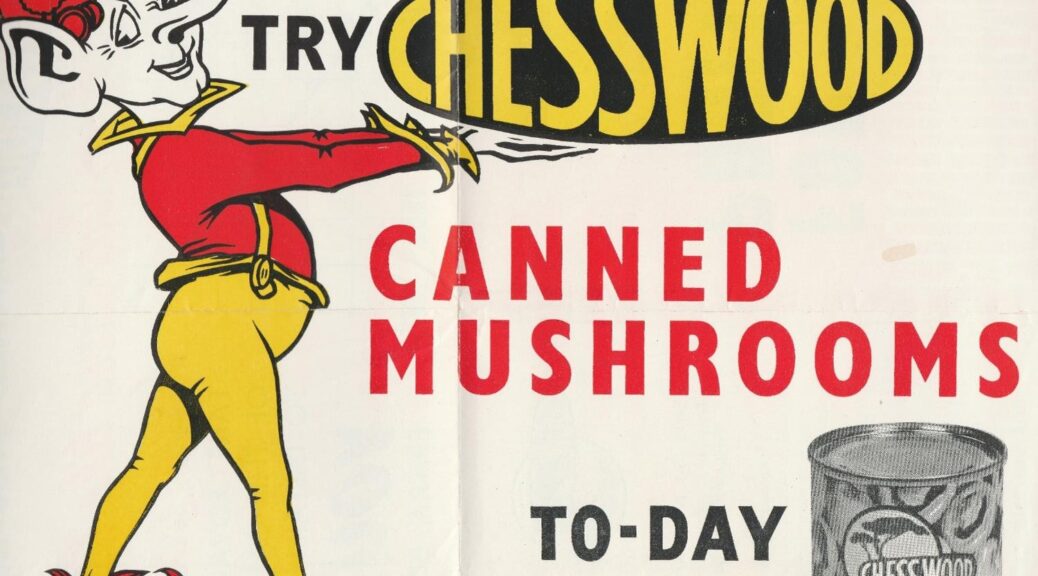
In 1913, the Worthing firm of AG Linfield & Sons purchased a dilapidated dairy farm at Thakeham from the trustees of the late Admiral Sir William Loring. Town House Farm was very run down, and even the old farmhouse had been dismantled and removed to a new location near Midhurst a year or so earlier (Fig 1). Arthur George Linfield (1859-1938) was one of the pioneer glasshouse growers in Worthing, having established his fruit growing business in the town in the early 1880s. Hothouse grapes were his most important crop, but after a few years he started to experiment with mushrooms, mainly by growing them as a catch crop beneath his grape-vines. Although mushroom growing in those days was a speculative and risky business, the profits could be high and their cultivation also provided work for the nursery workers during the quieter months of late Autumn and early winter.

Continue reading A brief history of mushroom growing at Thakeham in West Sussex

Harry Stanford Smith and the Linfields of Storrington

Earlier this year, Alan and I were excited to hear from some relatives of Harry Stanford Smith. This was out of the blue and came as a complete surprise, especially as over the years a number of us have taken steps to try and discover what may have happened to Stanford’s papers after he died in 1960, but to no avail. We were particularly keen to find out some of the sources he used, particularly in reference to his early research into the origins of the family before parish registers started in the mid-1500s. A previous article of mine (‘The Stanford Smith Papers) explains the importance of Stanford Smith’s researches in the 1950s when he became the first person to do any meaningful study into the genealogy of the Lin(d)fields1.

Continue reading Harry Stanford Smith and the Linfields of Storrington

BOOK REVIEW: ‘Fever! The Year Worthing Died …’

Fever! The Year Worthing Died. A comprehensive account of the 1893 Worthing Typhoid Epidemic.

Edited by Colin Reid. Price £14.99. Published by the Friends of Broadwater and Worthing Cemetery, October 2023.

The Worthing Typhoid Epidemic of 1893 was the greatest disaster ever to befall this seaside town, made worse at the time by the misguided incompetence of the Town Council and the way certain people exploited the situation to make themselves rich. Nearly 200 people died and the town turned into the ‘city of the dead’. The epidemic destroyed the carefully nurtured image of Worthing as a healthy seaside resort and the town never fully recovered.

This new book is the first comprehensive account of this terrible tragedy, covering many different aspects of the disaster, with detailed analysis and research; including a full list of all those who sadly died from the disease. It was written by a group of local researchers, which includes Colin Reid, Mary Mckeown, Chris Hare, Malcolm Linfield, Caroline Nelson and Marion Woolgar. Full of fascinating photos, it is a compelling read for all those with an interest in the history of Worthing and who may have family connections with the events described.

Continue reading BOOK REVIEW: ‘Fever! The Year Worthing Died …’

Jomo Kenyatta: further connections to Sussex

I have always regretted not being able to find any photos of Jomo Kenyatta during his wartime years in Sussex – apart from the one allegedly showing him destroying a wasps’ nest and a blurry image of him waving from the balcony of his wartime home at Heath Common near Storrington, that was about all. Many years ago, I was told by a cousin that he had once seen photos of Jomo when he was employed as an agricultural worker at Linfield’s nurseries in Thakeham; he had been shown them by Miss Mabel Willmer, who had occasionally worked with Jomo during the war, and secretively kept them in an old biscuit tin, only to be brought out on special occasions. Unfortunately, after she died, they were never found and she probably destroyed them. Apparently, she really admired Jomo’s flamboyant signet ring which he promised he would give her one day!

Over the years I have made various requests in the media for any surviving photos of Jomo during his time in Sussex, but the effort has always failed to come up with anything. One of the objectives for writing my article about Jomo Kenyatta and his connections with West Sussex was to put the story in the public domain. Therefore, out of the blue, I was very excited when I received a ‘comment’ to our website from Karen Heald who had stumbled across my article on Kenyatta; she said ‘I have lots of photographs of him in Sussex before and during the war including the full sequence of the wasp nest incident taken by my grandfather’. Of course, I immediately got in touch and she was able to send me a cache of some 30 images, many of which are reproduced in this article, thanks to her kindness and her desire to make them available to a much wider audience.  

Continue reading Jomo Kenyatta: further connections to Sussex

TAKING ANOTHER LOOK AT THE BRAMBER CASTLE LEGEND

The recent communication from Margaret Abbey has reawakened my interest in the legend of Bramber Castle. Every so often, the story appears in one of the local papers or free magazines but there has never been the slightest evidence to prove any of it actually happened. At the end of my article from 1992, I posed a couple of questions: ‘Who was Herbert Erredge and when did he write his ‘history’ of Bramber Castle, and secondly, did Lord Hubert de Hurst and Lady Maud actually exist? If they did not, then the legend of Bramber Castle is pure invention’. Unfortunately, nothing has changed to alter my view, although I think I now have a better idea of why the ‘legend’ evolved and the reasons behind its creation. Continue reading TAKING ANOTHER LOOK AT THE BRAMBER CASTLE LEGEND

THE VALUE OF NEWSPAPERS TO FAMILY HISTORY: SOME OF THE MORE EXTRAORDINARY STORIES INVOLVING MEMBERS OF THE LIN(D)FIELD FAMILIES


Newspapers provide some of the most detailed and fascinating glimpses of our ancestors and are a major source of information. Now that so many newspapers are being digitised and made available online, most notably by the British Newspaper Archive, and can be searched by name or any other category, this has become a major resource for all family historians. Thousands of new pages are added every day, so as time passes by, this amazing site will become even more valuable as a resource to all researchers.

Over the past few years, I have been building up a collection of material which I would very much like to share with our readers. I will continually add to this archive and hope to make comments on some of these entries where we have further information. I would also invite comments from anyone who can add their own contribution, as many of these entries relate to individuals about whom we know very little or, indeed, nothing at all. I have also decided to put each clip of news into a category, such as ‘heroic’, ‘criminal/misdemeanour’, ‘tragic’, ‘humorous’ and so on. Continue reading THE VALUE OF NEWSPAPERS TO FAMILY HISTORY: SOME OF THE MORE EXTRAORDINARY STORIES INVOLVING MEMBERS OF THE LIN(D)FIELD FAMILIES

JOMO KENYATTA AND HIS CONNECTIONS WITH WEST SUSSEX – NEW REVISED VERSION FOR 2019

My initial interest in Jomo Kenyatta, first President of Kenya, was inspired by his links with my family during the Second World War. I knew he had spent most of the war years working as a farm labourer at our family business in West Sussex. I remember my grandfather telling me many years ago that he had Kenyatta over to lunch when they discussed politics, among other things. I don’t expect they always agreed on everything, but my grandfather had obviously found him to be an interesting and intelligent man, and he was intrigued enough to find out what he had to say for himself. In fact, Kenyatta gave him a book he had recently written, called ‘My People of Kikuyu’ and he wrote inside the front cover: ‘To AG Linfield. With best wishes, Jomo Kenyatta. 17-4-42’ (Fig.1). The fact that my grandfather kept this book for over 30 years, before passing it on to me, surely indicates a certain respect for this man and his views, even though Kenyatta’s opinion of the British Empire was undoubtedly quite different to his own. I regret now not asking him what he thought about the ‘Mau Mau’ rebellion and Kenyatta’s role during this colonial crisis.   Continue reading JOMO KENYATTA AND HIS CONNECTIONS WITH WEST SUSSEX – NEW REVISED VERSION FOR 2019