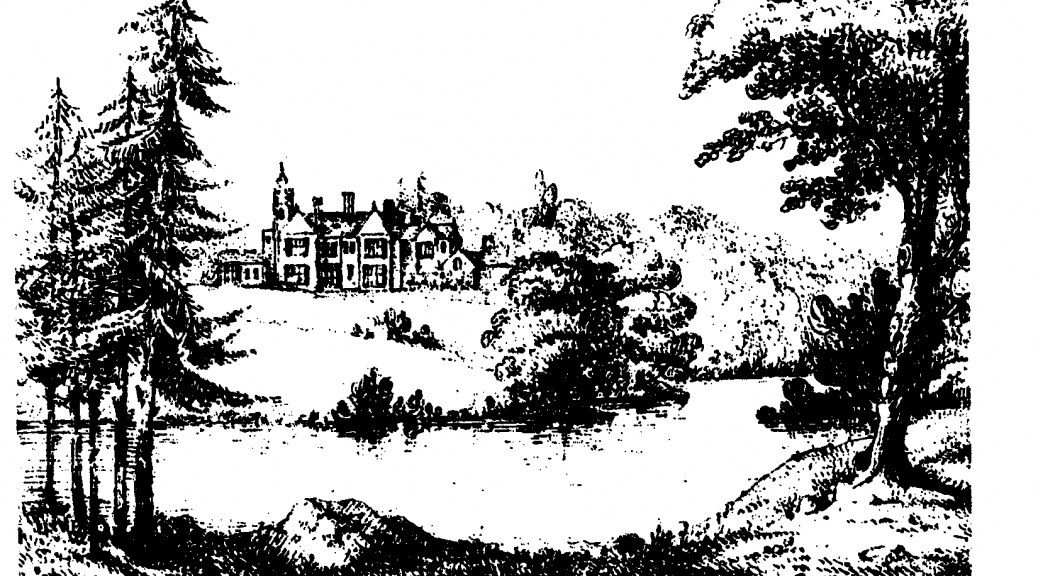
Following the recent publication of my article on the ‘Linfields of Coolhurst’1, I decided to write an adapted version for Horsham Heritage, the journal of Horsham Museum and Horsham Museum Society. Since I would need to write something of interest to a more general audience, it was necessary to exclude many of the family history details. The process of re-writing this article – with useful guidance from Sue Djabri of the Horsham Museum Society – proved to be a very interesting exercise in itself, leading, in fact, to a fundamental re-assessment of some of the ideas expressed in the original. The version which appears in Horsham Heritage2 is therefore rather different to the one which appeared in Longshot. The purpose of this article is to discuss some of the main differences and the reasons behind them, and to look at one or two new ideas which evolved during the process. Continue reading The Linfields of Coolhurst – an Update
All posts by Malcolm Linfield
Longshot Vol 10, No. 1
The Linfields of Coolhurst – an Update, by Malcolm Linfield
Linfield and Lindfield Wills and Administrations (1858-1943) Part 3: 1904-1920, by Alan Lindfield
Letters Page
Ipswich Borough Record Extracts Pt II (1559–1624), by Ian Anderson
Memorials to the Dead of the First World War, by Malcolm Linfield
Minutes of Annual General Meeting, June 1st 2002.
Portrait Gallery, by Malcolm Linfield
Front Cover: the Memorial Scroll issued to commemorate the life of Private Harold Frank Linfield of the Royal Sussex Regiment. See article on page 27.
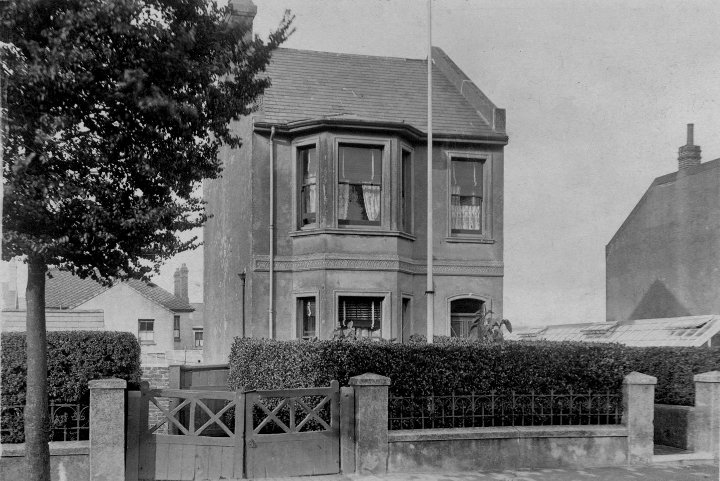
The Linfields of Lyndhurst Road, Worthing
Previous articles have been written in this journal about Arthur George Linfield, fruit grower and nurseryman, of Worthing in Sussex and his younger brother, Frederick Caesar Linfield, corn merchant of Worthing and local politician who eventually became a Liberal Member of Parliament. In this article, I intend to write about their elder brother, William Henry Linfield and his family, who lived in Lyndhurst Road near Worthing Hospital. Continue reading The Linfields of Lyndhurst Road, Worthing
A Tribute To Eric’s Life in Education
The following tribute to Eric was given by friend and former work colleague Don Bourne at a Thanksgiving Service on Thursday 29th August, 2002 at St. Mary’s Church, Saltford. We are very grateful to Don for his kindness in allowing us to reproduce it here for the benefit of a wider audience. Don was one of Eric’s many friends – for a total of 39 years – 21 of them as a colleague at Newton Park College, Bath. Continue reading A Tribute To Eric’s Life in Education
Eric Linfield – An Appreciation
It is with great sadness that I must announce the passing of Eric Linfield. Eric died peacefully in Bath Hospital after suffering a stroke on 16th August 2002. He was 81. Eric was, of course, the first President of the Lin(d)field One Name Group, from the moment of its inauguration in February 1992 until he stood down in 1999.
As family historians, we owe an enormous debt to Eric. His interest in family history was ignited by a newspaper article he read in 1963 describing the Golden Wedding celebrations of Evelyn May Page (nee Linfield) and Joe Page, who were caretakers of the Village Hall in Storrington. This article explained how Harry Stanford Smith had done some research on the Linfields during the 1950s, and had drawn up a detailed family tree going back to the time of the Anglo-Saxons. Eric duly wrote to May Page who provided him with a copy of the famous Stanford/Linfield tree. College work kept him very busy throughout the 1960s, but from the late 60s/early 70s, Eric began his research in earnest, spending many hours at the Public Record Office and at the West and East Sussex Record Offices.
After some early difficulties, Eric eventually managed to fit his branch into the Stanford Smith tree. He was able to show how he descended from Peter Linfield (1734-91), Farmer and Butcher of Storrington, through a younger son, Edward Linfield (1774-1861), who had a market garden at Sullington. I remember his immense pleasure when I was able to send him a photograph of his great great grandfather, Harry Linfield (1807-78), who was a farm labourer on the Sandgate Estate for over 50 years. This pictorial treasure, which shows Harry wearing a traditional Sussex smock, had been discovered by local historian Joan Ham in a book of old photographs belonging to the Carew-Gibsons of Sandgate House.
Eric was born on 25 April 1921 in the Sussex village of Henfield, son of George Mark Linfield and Annie Knapp, who were married in 1916. His sister Eileen followed in August 1922. Unfortunately, his father had a serious accident whilst tree-felling at Woodmancote Place in December 1922, and he never worked again. His childhood was far from easy, but Eric was an intelligent and very able child who was able to do extremely well for himself at school. Between 1928 and 1931, he attended the Henfield (CE) Elementary School, before moving to Steyning Grammar School as a rural scholarship boy. He was called up to serve during the Second World War, spending the latter part of the conflict in France. On returning to England in 1945, he went to university, initially at Oxford for a year and then to Cambridge, where he read Moral Sciences, specialising in Psychology in Part II. Later on, he took a second degree, a M.Ed. in Curriculum Theory, at Bristol.
After graduating, Eric decided to become a teacher and after a number of appointments around the country, he moved with his wife Sheila (they were married in December 1956) and their young family – they had two daughters, Janet and Julia – to Saltford in order to take up a new post as a Senior Lecturer in Education at the City of Bath Teacher Training College at Newton Park. This was in August 1963. Here he remained until retirement in 1984, a well-liked and approachable figure, with an irrepressible enthusiasm for knowledge across a wide range of subjects – family history being just one of them! He continued his part-time tutoring for the Open University until 1988, something he had started in 1975.
I first made contact with Eric in 1973, to answer a letter he had sent to the West Sussex Gazette (which my grandfather had noticed and passed on to me). This was just before he sent out his mailshot to every Linfield in the UK telephone directories, appealing for others to help him in his quest to build upon the original researches of Stanford Smith. His eventual aim was to write and publish a pamphlet or book about the Linfield story. In his letter, Eric asks to hear from any readers who might have remembered his grandfather George Linfield, who married Katherine Leach at Clapham in 1885. Katherine was in service at Castle Goring, whilst George was a cowman. I wrote to Eric, stating my interest in family history, and so began a regular correspondence which continued for the next 29 years!
Eric’s letters were always very helpful, full of encouragement and useful tips on how to proceed with a particular piece of genealogical research. We would often up-date each other with our successes, and I was most pleased when I was able to tell him that I had finally found the link connecting my own particular branch with the Stanford Smith tree. This resulted from his suggestion that I ought to have a detailed look at the Nuthurst parish registers, where I discovered the baptism of my great great great grandfather, Henry Linfield on June 12th 1796. I’ve always had a sneaking suspicion that Eric knew I would find this link, since it was rather odd that he had recorded the baptism of Henry’s sister Ann in 1792 but had apparently ‘missed’ the entry for Henry! I first met Eric and Sheila in person when I was invited to meet them at their home in Saltford towards the end of 1978. I was immediately struck by Eric’s infectious enthusiasm, as all these boxes of books and papers were miraculously produced and their contents duly scattered about the living room floor. Poor Sheila!

Eric enjoys himself at the Group’s 10th Anniversary event at the Old School, Storrington on June 1st 2002.
When we both met Alan Lindfield for the first time in July 1991, the whole business of the Linfield family history was suddenly transformed into the computer age. Alan explained how he had set up a database of Lin(d)field records and we were both mesmerised with the new possibilities that this modern technology could offer. One of the outcomes of this fruitful meeting was the decision to set up of a Lin(d)field One Name Society, something which greatly appealed to Eric because it represented a new and exciting phase in the development of the family history. It would bring together many more people who would be able to help with the research, whilst the publication of a members’ journal fulfilled Eric’s hopes that parts of the family story would be properly recorded for future generations.
Eric contributed regularly to ‘Longshot’, mainly with articles about his Sullington ancestors and his thoughts on possible avenues for future research. He was aptly appointed the first President of the group, and his letters of encouragement were a great support to Alan and myself as the project gradually unfolded. We were both very pleased that he was able to attend the 10th anniversary of the Group at Storrington on June 1st, when he thoroughly enjoyed himself and was able to meet many of the people with whom he had corresponded over the years.
Eric was also a very generous benefactor of books from his extensive collection, at one time, I believe, numbering some 20,000 volumes! We reported in an earlier edition of this journal how he donated his collection of books on humour to the library at the University of Kent in Canterbury.1 He also gave his fascinating collection of books on Sussex – some 98 volumes – to the recently established Storrington and District Museum, and this forms the nucleus of their fledgling library. A condition of this gift was that members of the Lin(d)field One Name Group can borrow any of these books to help them with research work. 2
Needless to say, we are going to greatly miss Eric’s words of wisdom and encouragement. He achieved so much in the field of family history as, indeed, he did in so many other areas. It was a privilege to have known him, and I shall always fondly remember the times when we enjoyed a pint or two in one of the local hostelries as we animatedly discussed some of the finer details of this strange hobby that had brought us together. Eric was unique, a loyal and kind friend and on behalf of us all, I would like to express our condolences to Sheila and their two daughters, Janet and Julia and their respective families.
1 The Linfield Library of Humour, by Malcolm Linfield in ‘Longshot’ Vol. 4 No. 1 (June 1995) p. 25.
2 If any member would like a copy of this list of books, please contact me directly.
Longshot Vol 9, No. 2
Eric Linfield – an Appreciation, by Malcolm Linfield
A Tribute to Eric’s Life in Education, by Don Bourne
Linfield and Lindfield Wills and Administrations (1858-1943) Part 2: 1877-1903, by Alan Lindfield
Out for the Count, by Alan Lindfield
Ipswich Borough Record Extracts, Part 1, by Ian Anderson
A Coat of Arms for the Suffolk Lin(d)fields, by Ian Anderson
The Linfields of Lyndhurst Road, Worthing by Malcolm Linfield
Front Cover: the Arms of the Lin(d)fields of Suffolk, as drawn by Ian Anderson. The proper colour of the heraldic shield is gold (Or). See article by Ian on page 64.
Longshot Vol 9, No. 1
Retained Fire Service Experiences, by John Linfield
How Rare is our Surname? by Alan Lindfield
The Linfields of Coolhurst, by Malcolm Linfield
Portrait Gallery, by Malcolm Linfield
Linfield and Lindfield Wills and Administrations (1858-1943) Part 1: 1858-76 by Alan Lindfield
Front Cover: Anne Linfield (nee Caesar) 1822-95, wife of William Linfield of Worthing. They were married in Brighton in 1850. Their youngest son was Frederick Caesar Linfield (see article p. 34).
Portrait Gallery

Frederick Caesar Linfield and family c. 1892
The formal portrait shown above depicts Worthing Councillor Frederick Caesar Linfield and his family, c. 1892. Frederick was the youngest son of William and Anne Linfield of Worthing, and was born on 23 September 1861. His name has appeared several times in previous issues of Longshot,1 and include stories about the disastrous fire which severely damaged his work premises in 1889 (he was a corn merchant) and his enthusiasm for the telephone, when he became one of the first people in Worthing to have it installed in 1886.
Frederick was actively involved in local politics, and became one of the first councillors at Worthing when the borough was incorporated in 1890. Promoted to Alderman in 1893, he was Mayor of the town between 1906 and 1908 and remained on the council until 1915. He then moved with his wife to London to pursue his political ambitions, which eventually saw him elected as Liberal Member of Parliament for Mid-Bedford in 1922. During the First World War, he worked in the Ministry of Munitions Inventions Department and was awarded the MBE. In 1924, he was a member of an East African Parliamentary Committee, which visited Northern Rhodesia, Nyasaland, Tanganyika, Uganda, Kenya and Zanzibar.
Frederick married Kate Ayres, a dressmaker on 10 April 1884. They had two sons and two daughters. She is shown in the photograph with their eldest son, Frederick William (grandfather of our membership secretary, Barry Linfield) born 23 January 1885, and their daughter Beatrice Kate, born in 1888. Another son, Herbert John (Jack), was born on 24 July 1892, and another daughter, Mary Gertrude, who was born in January 1896. Sadly, they lost both their daughters in 1896, Kate at the age of 7, and Gertrude at 9 months. Their little gravestones can still be seen at the cemetery in South Farm Road, Worthing.
Kate died in February 1929; Frederick lived another ten years, and died on 2 June 1939 at his home in Balham. He was buried in a grave next to his wife at the South Farm Road Cemetery.
The photograph on the front cover shows his mother, Anne Linfield who was the only daughter of Benjamin Julius Caesar of Godalming. Her brother was the famous Surrey and England cricketer, Julius Caesar whose tragic life has been the subject of a previous article in Longshot.2

Incidentally, I have a couple of interesting items that belonged to this lady: the first is a very worn kitchen spoon, which she had apparently used all her life for cooking, whilst the other is her fascinating birthday book. This little document provided a very valuable piece of genealogical information since it records the date of birth and death of her father-in-law, Henry Linfield who was born on 4 May 1796, and died in Brighton on 5 November 1873. Henry moved about quite a bit during his life, and when his children were born in the 1820s he was working as a gardener (perhaps a market gardener) in Croydon. But where did he come from?
Having the date of his birth proved an extremely useful clue. It was whilst researching the parish registers of Nuthurst in West Sussex that I discovered that a Henry Linfield was baptised on 12 June 1796, son of James and Elizabeth Linfield. Could this be him? The baptism date would fit perfectly. Henry lost his wife in 1826 during childbirth, so I wondered whether he may have remarried. Through trial and error, I managed to find that indeed he had: in 1842, he married a widow, Harriet Ann Plumridge, a bootmaker’s daughter, in Middlesex. I was convinced this was the right marriage because the informant on Henry’s death certificate was H.A. Linfield. But crucially, the marriage certificate gives the name of Henry’s father, ‘James Linfield, deceased’. I’ve still to find a census entry for Henry, which should confirm his place of birth as Nuthurst.
Henry had obviously left Nuthurst as a young man to “seek his fortune elsewhere”. Agricultural depression was severe in Southern England after the end of the Napoleonic Wars, and remote rural parishes like Nuthurst could only provide a modest living for a limited number of people.
1 Family History from Old Newspapers, by Malcolm Linfield Longshot Vol 1 No 1 (May 1992) pp 18-19.
Roots and Cuttings, by Alan Lindfield Longshot Vol 3 No 1 (May 1994) p. 35.
William and Anne Linfield of Worthing, by Malcolm Linfield Longshot Vol 2 No 1 (May 1993) p. 27.
2 The Caesar Connection Part 3: The Tragic Life of Julius Caesar, by Malcolm Linfield in Longshot Vol. 5 No. 1 (Aug. 1996) pp. 11.