In 1913, the Worthing firm of AG Linfield & Sons purchased a dilapidated dairy farm at Thakeham from the trustees of the late Admiral Sir William Loring. Town House Farm was very run down, and even the old farmhouse had been dismantled and removed to a new location near Midhurst a year or so earlier (Fig 1). Arthur George Linfield (1859-1938) was one of the pioneer glasshouse growers in Worthing, having established his fruit growing business in the town in the early 1880s. Hothouse grapes were his most important crop, but after a few years he started to experiment with mushrooms, mainly by growing them as a catch crop beneath his grape-vines. Although mushroom growing in those days was a speculative and risky business, the profits could be high and their cultivation also provided work for the nursery workers during the quieter months of late Autumn and early winter.

Worthing’s glasshouse industry boomed throughout the 1880s and 1890s as more and more growers took the plunge and started to do very well for themselves. Worthing’s favourable climate and soil enabled the local growers to specialise in early glasshouse produce which fetched premium prices in the main markets. This gave them a distinct advantage over their competitors, and “Worthing Grown” became a nationally recognised standard for top quality produce. Arthur Linfield eventually had several nurseries in the East Worthing area, his main crops being grapes, tomatoes, cucumbers and mushrooms.

In 1912, Arthur and his eldest son, Arthur junior, began searching for a farm in the country to provide job opportunities for the younger sons in the family. They obviously saw the potential of Town House Farm at Thakeham, with 169 acres of land, and soon after acquiring the site they started to erect some new buildings, including a granary (Fig 2), some cattle sheds and a number of purpose-built mushroom houses.
These early mushroom sheds were made of wood and thatched with straw, which provided excellent insulation (Fig 3). The mushrooms were grown in beds of compost spread over the floor (Fig 4), much in the same way that they were being grown in the greenhouses at Worthing except that they could be grown all year round. But they were a risky crop and would often fail because of the variability of the spawn, which was usually collected locally from old compost heaps.


A promising looking spawn from the ordinary field mushroom agaricus hortensis would then be ‘planted’ into a special holding bed where it would slowly colonise the medium. Once fully colonised, It would then be broken up into small pieces and pushed into new mushroom beds at regular intervals. The mycelium would slowly spread through the compost, eventually knitting together on the surface of a thin layer of ‘casing’ soil to form the small pinheads. These would grow on into the first crop of mushrooms. At this stage, there were no plans to build any greenhouses at Thakeham.

The outbreak of war in 1914 necessitated bringing the farm fully back into cultivation as quickly as possible. County War Agricultural Committees were set up to control the production of food and direct farmers on what crops they should be growing. Cattle were introduced and German prisoners-of-war were taken on to help with the ploughing and other farm activities (Fig 5).
Land army girls took over many of the jobs formerly done by the men who had left to join up, and several photographs show them working in the mushroom sheds and on the farm (Fig 6 & 7). Of Arthur’s seven children, his eldest son and daughter worked with their father to keep the business going, whilst the others all joined up. Sadly, one son, Harold was killed on the Western Front in May 1915.


The inter-war years proved difficult for all farmers and growers after wartime controls were removed in 1921. Wages and farmers’ profits plunged, not surprisingly as the government was reluctant to help the agricultural sector in the face of unfair competition from abroad. The Worthing glasshouse growers were unable to re-establish the vineries they had been forced to rip out during the war because of foreign dumping of grapes on the home market and the refusal of the government to introduce protective tariffs. The tomato became the most important glasshouse crop, with flowers and mushrooms becoming more widely grown, especially after the invention of pure culture spawn, which removed some of the uncertainty involved in their production.

Some of the larger growers attempted to reduce costs to make them more competitive. Linfield’s, for instance, installed ‘central heating’ using two large Lancashire boilers at their Ham Road nursery, creating a more economical and efficient system of heating the glasshouses instead of using a multiplicity of small boilers in sunken stokeholds.

Due to the depression in agriculture, more drastic action had to be taken at Thakeham, with much of the land rented out to a neighbouring farmer. The outdoor crops comprised a small acreage of potatoes, some 10 to 12 acres of flowers, chiefly carnations and chrysanthemums, some strawberries and outdoor tomatoes. However, more mushrooms were being produced, not only from the purpose-built sheds at the top of Town House Farm, but also from three acres of outdoor ridge beds (Fig 11).

In the early 1930s, Linfield’s experienced a financial shock when their bank demanded an immediate re-payment of £1,000 on their overdraft facility. Arthur jun. approached his younger brother Wilfred, who had started a building company with a friend, pleading for financial support to cover the pay roll until sufficient revenues came in. Luckily, Wilfred was able to oblige and the firm managed to pull through after receiving payment from flower and strawberry sales.
The need to urgently raise more capital was probably an important consideration behind the decision to gradually shut down the Worthing nurseries, which could then be developed for new housing. In 1934, the glasshouses at Chesswood Farm Nurseries in Ladydell Road were carefully dismantled and re-erected at Thakeham. By the end of the decade, Linfield’s had sold all its sites in Worthing and transferred the whole business to Thakeham. Under the new glass, the chief crops were carnations, chrysanthemums, mushrooms, hothouse beans and some grapes. Sadly, the founder of the business, Arthur Linfield senior died in 1938 at the age of 79. He was succeeded as head of the firm by his eldest son, Arthur jun., who became Chairman when the business was incorporated in June 1940 as AG Linfield Ltd.
In many ways, the outbreak of the Second World War provided a vital lifeline as the company geared up to play its part in the national strive towards self-sufficiency in food production. Once again, county-based War Agricultural Committees imposed strict rules on which crops should be grown, and where. In 1939, the firm took back control of all its farm land, and underwent a major restructuring in order to use all the glasshouses and land for food production. All indoor and outdoor flowers were reduced to less than 10% of the pre-war acreage, with tomatoes becoming the most important glasshouse crop throughout the war period. In winter the glass was used to produce salad crops. Outdoor tomatoes were also grown on six acres of the farm. Mushrooms were considered of little food value and production was significantly reduced – however, Linfield’s grew what they could, mostly in the purpose-built houses which could not be used for anything else, because they fetched very favourable prices. Forty acres of land were also now under overhead irrigation.

It was during this period that Linfields’ most famous employee, Jomo Kenyatta, later to become the first President of Kenya, worked as an agricultural labourer on the princely sum of £4 per week. Not being able to return to Kenya, he was persuaded by a friend to move to Sussex to avoid the bombing raids in London and came to live near Storrington in 1940. He soon found work at the Thakeham nurseries, and was initially put to work in the tomato hothouses. He returned to Kenya in 1946 to lead the movement for independence.
The firm did well during the war years, reflected in 1944 with the purchase of an old dairy farm at Abingworth. The estate of 146 acres was purchased for £8,750. In March 1945, it was decided to explore the idea of setting up a holiday camp at the Abingworth Farm. However, work soon began to convert many of the redundant buildings to mushrooms.

Arthur Linfield recognised the importance of specialisation after the bitter experience of the 1930s and pushed for the firm to significantly expand its mushroom growing operation. Tomato production was cut right back, and many of the glasshouses were converted over to mushrooms. With the shortage of materials, improvisation and ingenuity were the order of the day, and the greenhouses were transformed using glass-fibre panels which were secured to the glass with wire mesh and wooden lathes (Fig 13). This kept out the light and provided insulation.

As for the new mushroom shelving, this was constructed using old army beds whilst the supports came from Worthing’s wartime sea defences! (Fig 14). Figs 15-21 show the sequence of the growing operation from compost yard to packing shed as it functioned in 1950.


Linfield’s also sought out the best technical and cultural advice from international experts, which enabled them to surge ahead in productivity and leave their competitors behind. In the 1950s, they were among the first in the country to adopt a sophisticated system of mechanisation which introduced growing in trays and all the advantages entailed in fast and efficient handling of materials. New compost turning machines could do the work of 15 men in a fraction of the time, whilst new cultural techniques made mushroom growing less risky in terms of productivity. A secondary pasteurisation procedure known as Phase 2 was introduced whereby the filled trays were stacked closely together in pasteurisation rooms to increase the effectiveness of the composting process. Then the trays would be moved to a spawning line by forklift truck and taken to spawn rooms to be fully colonised by the mushroom mycelium, prior to casing and removal to the growing houses. All these processes would be carried out by forklift trucks, which made it fast and efficient and enabled an enormous increase in productivity. By 1956, the firm was growing 5 million lbs of mushrooms per year.

Halewick Farm nurseries in Sompting were purchased from Herbert Sparkes in 1943 and Ashington nurseries from a Mr Champion in 1953. Both sites were substantially altered to include mushroom growing facilities. A pig farm was established at Thakeham in 1953, with the waste products being conveniently added to the mushroom compost. But the firm was finding it difficult to recruit sufficient workers locally for its expanding enterprise at Thakeham; the Board decided to set up its own transport runs to bring workers in from further afield.

In 1956, Linfield’s purchased Lyons Farm Nurseries in Sompting from H.A. Pullen-Burry with the idea of significantly increasing its production of mushrooms. Four acres of glasshouses were swiftly converted and mushrooms were already being harvested before Christmas. In 1957, overall production by the company had increased by 50% to 7.5 million lbs per annum.

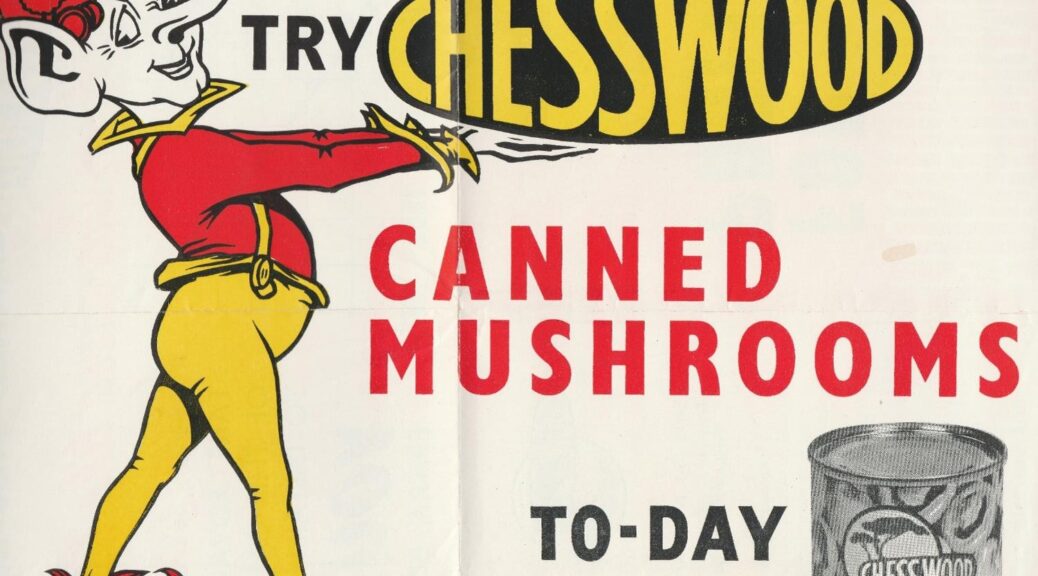
Another major investment was undertaken in 1958 when the business decided to invest in a cannery at Thakeham. It was at this time that the ‘Chesswood’ brand name was adopted, used to aggressively promote the new range of canned mushroom products on the market (Fig 24). By 1960, the company was growing 10 million lbs of mushrooms per annum and employing 600 people, and for a brief period Linfield’s were acknowledged as the largest mushroom growers in Europe.
Although it proved enormously successful, an unforeseen crisis in the early 1960s gave the board little choice but to sell the cannery. The reason was a serious outbreak of virus disease which reduced mushroom production by 100,000 lbs a week. After some very thorough and painstaking investigations by Harold Linfield and the firm’s consultant, Dr. J.W.(Jim) Sinden of Penn State University, the outbreak was eventually traced to the dissemination of infected mushroom spores. These were inadvertently spreading all over the place from large crates of open cap mushrooms left outside the cannery in readiness for processing. Apart from removing the immediate hazard, an important precaution involved the installation of sophisticated air filtration units in all of the spawning rooms. The significant loss in productivity and the costs of putting it right had serious financial implications which meant the firm needed to urgently raise some capital. Hence the sale of the cannery with all the canning rights to Cerebos Foods, which closed the factory at Thakeham in 1963 and transferred the business to Vauxhall. The official explanation was fairly ambiguous and to the effect that Linfield’s wanted to concentrate on the principal business of the firm, which was growing. However, at least the new canning operation still wanted large quantities of Linfield’s mushrooms.
In addition to mushrooms, cut flowers were also being grown in large quantities – mainly roses, carnations, chrysanthemums and orchids. By now, there was only half-an-acre of tomatoes, although cucumbers were still being grown in quantity whilst outdoor lettuces and strawberries were still significant crops in the summer. Large numbers of pigs, turkeys and broiler chickens were also being reared on the farm.
Unfortunately, the late sixties were marred by another ‘crisis’ which threatened the future of the whole mushroom industry. A scientific paper published in the British Medical Journal in 1967 purported to show that fungal spores were causing a nasty disease called ‘Mushroom Workers’ Lung’. Such serious allegations meant that Linfield’s had little choice but to try and prove the research was flawed. Luckily, their relationship with the unions was very good and they fully supported the company in its quest to fight back against the potential damage to the industry and its workforce. It was arranged that every worker engaged in mushroom production at Linfield’s would be dispatched to the Brompton Hospital for tests, a huge undertaking, but it proved that nobody had such a disease and therefore the claims were discredited. Two mushroom pickers were found to be allergic to mushrooms so were transferred to carnation work.
It turned out that what Alex Sakula was describing in his paper was no other than Farmer’s Lung disease which is caused by bacteria from mouldy straw, known as thermophilic actinomycetes. Prolonged exposure to mouldy straw in an outdoor compost yard could feasibly cause Farmer’s Lung disease, but the composting process in Phase 1 generates high temperatures of up to 80°C which would eliminate these bacteria completely. After filling into trays, the compost then went into the Phase 2 rooms for pasteurisation and conditioning – once heated to 58°C, it would be conditioned for several days at 48°C to remove any unwanted organisms from the substrate. Any compost disturbance, such as during spawning, causes a lot of dust and, as a precaution, Linfield’s installed state-of-the-art extraction fans to quickly remove dust particles from the working area around the spawning line.

Around 1970-71, money was invested in building new blocks of mushroom houses at Thakeham, whilst a new nursery was acquired at Climping in 1970 and another at Cokeham in 1973 (formerly Sompting Nurseries Ltd). Unfortunately, the Oil Crisis in 1973 caused a serious escalation in costs, coupled with production difficulties owing to a hot summer and poor-quality straw. The difficulty with growing mushrooms is that there are many variables to contend with which are not always predictable or controllable; despite increasingly sophisticated technology, mushroom growing will never become a fully automated factory process where everything is precisely controlled.
The story since 1980 is really one of constant changes and fluctuating fortunes. Control of the business passed to Rank Hovis McDougall (RHM) who became the major shareholder after purchasing the remaining family shares. The Linfield family were keen to sell to RHM as they had purchased Cerebos Foods in 1968 and already owned a significant amount of the share capital. It was hoped that selling to RHM would provide an ‘umbrella’ to secure the future of the business and its employees – but sadly, at a time when the business needed a serious injection of capital to modernise ageing facilities and improve its production capacity in the face of increasing competition, especially from abroad, it failed to materialise. A major drive was undertaken to reduce costs with the early closure of the nurseries at Cokeham and Halewick Lane, Sompting. Where suitable, extra trays were stacked into mushroom houses on existing sites to replace some of the lost production area.
The firm had to invest in a substantial refurbishment of the main packing shed at Thakeham to meet stringent supermarket requirements, whilst being encouraged to diversify into new areas, arguably at a time when it would have been better to concentrate on the core business of the company, growing mushrooms. Part of Willmer’s nursery at Town House Farm was put over to chicory and a new unit was set up in 1982 to grow oyster mushrooms. In April 1982, Linfield’s ceased to grow roses as part of its rationalisation programme although the rose growing operation would be taken over by existing employees.
The Lyons Farm Nurseries at Sompting, producing some 4 million lbs of mushrooms a year, were closed in July 1986, ostensibly due to the deteriorating condition of the growing houses, which made the site unviable. However, it was also very valuable building land and RHM were able to sell it for over £10 million to developers. Unfortunately, not all the money was re-invested in the business, at a time when it could have made a significant impact on securing the firm’s future in a climate of increasing competition and financial insecurity.

Nevertheless, the compost yard was roofed over, which improved the consistency of the mushroom compost since it was no longer exposed to all the vagaries of the weather, particularly heavy rainfall (Fig 26). And in order to make up the shortfall in production from the Lyons Farm closure, a new production unit was built at Thakeham. The Board opted for a turnkey Dutch Shelf System, although it was ill-conceived because it now meant they would be operating two completely different growing systems on the same site. Understandably, there were many problems with this, and eventually, some years later, the shelves were taken out and trays substituted.
However, RHM did make one very important investment which enabled the firm to dramatically recover its profitability. This was the decision taken when Peter Baker was managing director to build bulk pasteurisation tunnels to replace the old pasteurisation rooms, which were no longer fit for purpose. The old rooms had deteriorated to such an extent that they were poorly insulated and the top trays of compost were getting saturated with condensation, to such an extent that they were hardly producing any mushrooms at all. The Phase 2 pasteurisation process had become seriously compromised, resulting in a variable substrate and lower productivity.

The new pasteurisation system consisted of nine chambers, each with the capacity to hold 100 tonnes of compost (Fig 27). A controlled mixture of air and steam was forced through the compost mass via a perforated floor. The degree of control and efficiency of the new system was infinitely superior – by 1988, Chesswood were back into profit and the figures were starting to significantly improve.
In September 1987, the company name was changed to Chesswood Produce Ltd., which signified the new corporate identity desired by RHM to describe its overall mushroom operation, which also included a farm at Shepherds Grove in Suffolk, acquired in 1982. Combined annual output of mushrooms from the RHM farms was now estimated at some 30 million lbs. The sale to building developers of the nurseries at Climping and Wiston followed soon after, releasing more land to RHM’s substantial land portfolio.
Unfortunately, the revival of the firm’s prosperity was relatively short lived – an economic downturn in the early 1990s and the effects of increasing competition from foreign imports, particularly from Ireland and Eastern Europe, caused a major upset for the home growers. Many of the small and medium sized businesses collapsed as they could no longer cover their costs. A surprise takeover of RHM in the early nineties by Tomkins’ PLC heralded a very bleak period when there was no investment in the company for the following five years. Tomkins eventually decided to sell off the non-strategic businesses in its business portfolio, and among the RHM companies sold was Chesswood Produce Ltd., jettisoned in 1998.
An Irish firm, Kildare based Carbury Park bought the Suffolk-based section of Chesswood Produce, whilst the Thakeham plant was bought for £7 million by some sort of MBO, although precise details are scant. But in November 2001, a Dutch-based family-owned group – Heveco BV – purchased the Thakeham enterprise, putting forward ambitious plans to develop and modernise the plant. They proposed an increase in their UK production of at least six times, by expanding at Thakeham and acquiring another English mushroom farm. Initial investments were made in production buildings, temperature-controlled transport, IT and new pack house systems. But such impressive goals went little further.
By September 2006, Heveco were in serious financial difficulties, partly due to heavy competition, some unforeseen composting problems and allegedly a fire at the Thakeham plant, which forced the company into administration. This time the Chesswood and Abingworth sites were bought by a property investment and development company, Beamsync, which leased the mushroom plant to a newly created firm, Sussex Mushrooms Ltd., as part of an overall strategy to make money from the site by linking it to the long-term future of the mushroom growing operation. There was no question that Sussex Mushrooms urgently needed a substantial injection of capital to modernise ageing plant and make the business more competitive. But in order to raise this capital, controversial plans were put forward in 2008/09 proposing a large estate of houses be built on the Abingworth site.

Sweeteners were offered to try and secure local support prior to submitting a planning application. The proposal was to build 146 houses with community facilities and a playing field at Abingworth, much of it where the derelict growing houses were situated (Fig 28). All production would in future be concentrated on the Chesswood site, where a number of houses would also be built at the front for key workers. One of the carrots offered to the local community was the introduction of an aerated composting facility which, they claimed, would reduce the ‘mushroom odour’ by as much as 90%. Some people found the smell created by the outdoor composting process offensive, especially newer residents with less resilience to living in the countryside.
New growing blocks, a combined heat and power (CHP) unit and some new pasteurising tunnels were also envisaged as part of a new £10 million investment at the plant. Spent mushroom compost would be used to fuel the £1.8m CHP installation. Not surprisingly, there was much local opposition, and many people resented linking the future viability of the business with the need to build houses. Assuming a successful outcome from the planning process, the project was scheduled for completion by April 2014, and was expected to give the company a 30 per cent increase on its existing production capacity of some 140 tonnes of mushrooms a week. An initial planning application was submitted in July 2010, and was expected to go before the planning committee in 2011.
Unfortunately, volatile trading conditions adversely impacted on Sussex Mushrooms’ profitability before it was able to secure any of the envisaged funding from the housing scheme. By July 2011, the company was on the brink of insolvency. An interested buyer emerged when the Irish multinational Monaghan Mushrooms made an offer to purchase the failing firm. Once the terms were accepted, the assets and contracts of Sussex Mushrooms were transferred to a new company called Thakeham Mushrooms Ltd in August. Monaghan’s Chairman and Chief Executive Ronnie Wilson said they liked the strategic advantages of the site in the south-east but emphasised that ‘the capital injection from the new homes development is essential to kick start further investment and to deliver the vision set out by Sussex Mushrooms to create a state-of-the-art mushroom growing facility’. He also emphasised that there had been no significant investment in the facilities at Thakeham for nearly a quarter of a century, which was desperately needed to ensure its long-term survival in such a competitive market. Once again, the familiar promises were being made.

Abingworth Developments (the developer) continued with its two applications – the building of the new homes and the demolition and replacement of buildings on the Chesswood site – which were recommended for approval by Horsham District Council Planning Committee in September 2012, with the proviso that the housebuilder would contribute £3.75m towards ‘enabling works’ to continue the business viability. The Thakeham Village Action group (TVA) opposed the applications, but they were eventually passed by HDC in April 2013. TVA responded by launching a judicial review to challenge HDC’s decision, but this was rejected by the High Court judge on 29 January 2014 and TVA were ordered to pay £10,000 in costs.
Progress since 2014 was fairly significant, and it was hoped that with funding now secured from the housing scheme and the parent company, at last the modernisation programme would help to strengthen and consolidate the business for the future. Heavy competition continued to exert considerable pressure on prices, but large producers like Monaghan’s operated a business model of high output/low margins in order to remain profitable. This is in complete contrast to the old way of growing mushrooms which extended into the 1980s, when productivity was much lower and higher prices could be obtained (low output/high margins). In those days, there were many more producers, of all sizes, from small family businesses with a few sheds to the larger organisations like Darlington’s (Blue Prince Mushrooms), Linfield’s and Middlebrook’s. Another contrast with these earlier mushroom farms is that they would carry out the full cycle of production, from making and conditioning the compost, filling and spawning the trays or shelves, growing, harvesting, packing and marketing. From 1945, a national Mushroom Growers’ Association looked after the interests of hundreds of growers, the vast majority being family-owned businesses – but the growers’ organisation finally folded in 2005 due to lack of members. The industry is now dominated by a small number of large producers, all of Irish origin.
Nowadays, the trend is geared more to specialisation in particular processes (vertical integration), thereby improving efficiency and productivity. This enabled Monaghan to carry out its promise to the local community to remove the smell created by the outdoor composting process. In 2013, all the compost requirements for the Thakeham plant were transferred to a Monaghan subsidiary in Hampshire which specialises in making compost. This enabled the Thakeham team to completely shut down the old composting facilities, which were completely demolished. Subsequently, a large number of redundant buildings and old blocks of greenhouses were all cleared from the Chesswood site, whilst a number of new production houses and other facilities were built.
In May 2018, Monaghan announced a reduction in mushroom production at Thakeham from a proportion of its tray facilities, to include a significant conversion from conventional to organic and the introduction of exotic mushroom species to the site. They also stated that another area of the site would increase production, whilst tray height would be reduced from 4 high to 3 high to help with harvesting of the crops.
Although Monaghans made a promising start at securing the future of mushroom growing at Thakeham, although at a cost to the local community of a controversial housing development, it was generally hoped that their considerable investment in the business would ensure that mushrooms would be grown at Thakeham for many years to come. Sadly, however, adverse trading conditions continued to make the company unprofitable and in May 2022, the Monaghan board decided to cease operations at the site and close the farm completely.

This decision effectively brought to an end a total of 109 years of commercial mushroom growing in the village. The site has been given back to its owners who have sealed off the area and are currently in the protracted process of trying to obtain planning permission to build some 400 houses, deeply opposed by local residents who are understandably horrified at the scale of the plans and the unsuitability of this rural location. The battle commences, and with the current pre-occupation of the government to build new houses regardless of local opposition and environmental concerns, it will probably happen, which is a matter of deep regret.

I used to live on the mushroom farm in ashington, I’ve been looking for pictures of the mushroom farm
Hope u can help me
Kim Goddard