
Earlier this year, Alan and I were excited to hear from some relatives of Harry Stanford Smith. This was out of the blue and came as a complete surprise, especially as over the years a number of us have taken steps to try and discover what may have happened to Stanford’s papers after he died in 1960, but to no avail. We were particularly keen to find out some of the sources he used, particularly in reference to his early research into the origins of the family before parish registers started in the mid-1500s. A previous article of mine (‘The Stanford Smith Papers‘) explains the importance of Stanford Smith’s researches in the 1950s when he became the first person to do any meaningful study into the genealogy of the Lin(d)fields1.
His collection of letters outlining the progress of his researches to Arthur George Linfield and Katie Linfield are a part of our society archives; however, he did make mistakes so there has always been a need to check Stanford’s research to confirm the accuracy of his work. However, in the 1950s, there were no computers with instant online access to indexed census, civil and parish records. Parish registers were not in regional record offices but still kept in the local parish churches. Stanford was continually traveling to London to consult records in the British Library and the Public Record Office, so what he actually achieved was quite remarkable and we should, in fact, probably forgive him the errors.
We were therefore thrilled to meet Stanford’s niece Hazel Picking, daughter of his sister Gwendoline, and her son Tony Webb, Stanford’s great nephew. Stanford often stayed with the family at their home in Epsom, especially when he was having problems with iritis, which plagued him for some time and was extremely painful. Hazel remembered him sitting in front of the fire for hours on end, possibly during episodes when the pain was debilitating. We all met in March this year and had an interesting talk about their memories of him and learned a lot more about him. Among a number of items Hazel and Tony passed on to the Group was Stanford’s notebook, which shows he was not just investigating the Linfield and Stanford families, but also the Hobdens (on his mother’s side), and the Smiths and St. Johns on his father’s side. He also included a potted biography of his own life, which is reproduced here because it adds so much more to the scanty information we previously had about him:
Harry Stanford Smith (b. 1887). Schools, Mrs FitzHugh’s, Springfield Rd, B’ton, 1893-95, Towner’s Beaconsfield Villas, 1895-1899, Taunton House, Buckingham Rd (Clark’s) 1899-1902, Brighton College 1903-1904. Went into Fathers business 1904-1914. Joined 18th Rl. Fusiliers at Epsom 1914 as a private. Went to 4th Rl. Irish Fusiliers at Belfast (commissioned) 1915. In Dublin 1916. Attached to 2nd R. Irish Fusiliers on Solonica Front in 1916. Joined 2/6th Jats at Agra 1917 R.T.O Lahore 1918, attached 86th Malabar Light Infantry 1919. Commandant Ramandrug 1919, Recruiting Officer, Malabar 1920. Demobilized Oct. 1920. From 1920-1929, travelled in France, Austria, Germany, Italy, Yugoslavia, Albania, Greece, Spain, Portugal, Cyprus, Syria, Egypt, Sudan, Kenya, Tanganyika, Belgian Congo, Nigeria, Liberia, Algeria, Tunis, Morocco. A Director of Chromium Platers Ltd 1929-1930. Lived in London and Brighton 1930-1934. Had
a fishmonger’s business, Portland Rd Hove2 1934-1936. From 1936-40 lived in Brighton. Joined Censorship in Liverpool, 1940. Went to Port of Spain, Trinidad, in Censorship in 1941. In Germany (Peine, Berlin, Hamburg) in same capacity 1945-48. Since 1948 lived mainly in Brighton with summers passed in Oxford and Cambridge. Principle interests – history, archaeology and the study of languages. Born at 71 Ship St, Brighton.

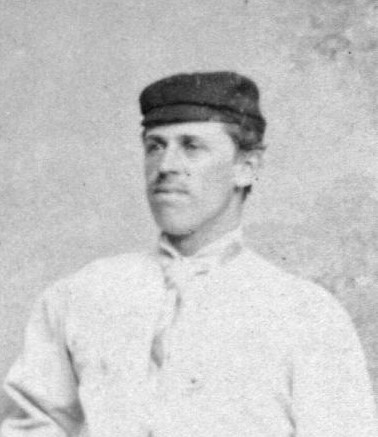
We also have one of Stanford’s passports, in which there is a photograph of him, shown in Fig. 1. Harry Stanford Smith was the only son of Harry Smith, auctioneer of Brighton and Hurstpierpoint. His Linfield connection came through his maternal grandmother, Emily Hobden, who was one of the many children of William and Harriet Linfield of Storrington in West Sussex. The main aim of this article is to look in detail at everything we know about the children of William and Harriet Linfield (which includes Stanford’s grandmother, Emily Linfield), adding in any ‘new’ information revealed in Stanford’s note book and more recent information found in the records which sometimes shows that Stanford was wrong in some of his assumptions. Since he is closer in time to his grandmother’s generation, not surprisingly he was privy to family information and stories not found anywhere else.
William Linfield (1769-1835) was baptised on 24 October 1769 at St. Mary’s Church in West Chiltington, eldest surviving son of Peter Linfield (1734 – 1791) of Palmer’s Farm and his second wife Sarah Sayers, whom he married in 17663 . A previous article (‘Peter Linfield of Storrington‘) goes into some detail about his life. Peter was born in the parish of Nuthurst, where his ancestors had lived for many generations. In 1778/79, the family moved to Church Street in Storrington where Peter set up in business as a butcher in the premises of a Mrs Nash in Church Street (No. 251 on the Bainbridge map of 1788/252 on the 1841 Tithe Map). Perhaps it was the opportunity of transferring to a busier location which prompted the move, although he still retained his copyhold property and lands at West Chiltington, which were let to John Humphries. In 1786, he took on his wife’s brother Richard as a butcher’s apprentice.
Peter’s name appears at least twice in old newspapers, on one occasion for slaughtering ‘a remarkably fine ox’ weighing nearly 190 stone, which belonged to Sir Cecil Bishopp of Parham Park.4 The other occasion was not quite so auspicious: in October 1779, he was forced to write a grovelling apology with Edmund Searl, another Storrington butcher, which was published for all to see in the Sussex Weekly Advertiser, for their Contempt of court on 10 February.5 Having appeared in front of Sir Harry Goring, Justice of the Peace, they had both refused to be sworn in for the purpose of proving that John Scardesfield of Storrington had sold two hares to Henry Baker, Farmer of Storrington. They were subsequently indicted to appear at the Quarter Sessions at Petworth to answer for their Contempt, but reached an agreement with the Justices to pay costs, a ten pound fine, and to ask Pardon ‘in this public manner’ for ‘such our Scandalous Behaviour’. Ten pounds was a very hefty fine at this time and presumably relates to what was considered a very serious offence. No doubt, if they had failed to pay, the alternative would have been a custodial sentence. Peter died in 1791 at the age of 57, and his butcher’s business and farm passed to his eldest son, William. His will and probate inventory indicate he was a man of wealth and status in the local community.
After Peter’s death, his widow Sarah continued to live at the house until her own death in 1805 at the age of 61. Their son William presumably continued to run the butcher’s shop from the same premises, but eventually moved the business to another building in Church Street, which still survives to this day and is currently called ‘Little Boltons’ with the original shop attached. This shop continued as a butcher’s until as recently as 1972 when it was owned by the Seldon family. Renovations some 20 years ago at the house revealed some interesting evidence of the ancient structure of this timber-framed building. Sometime around 1800, the main house was faced with brick although it wasn’t extended across the whole of the frontage until 1852 when the old shop was finally completed. It would appear that the commencement of butchering and slaughtering on the site may have started as early as the 1500s, with a separate building used as a slaughterhouse. The cellars of the main building were evidently devoted to the preparation, hanging and preservation of meat, as indicated by several ceiling hooks still in situ. Before the days of refrigeration, the cool cellars would have provided the best available conditions for this purpose.
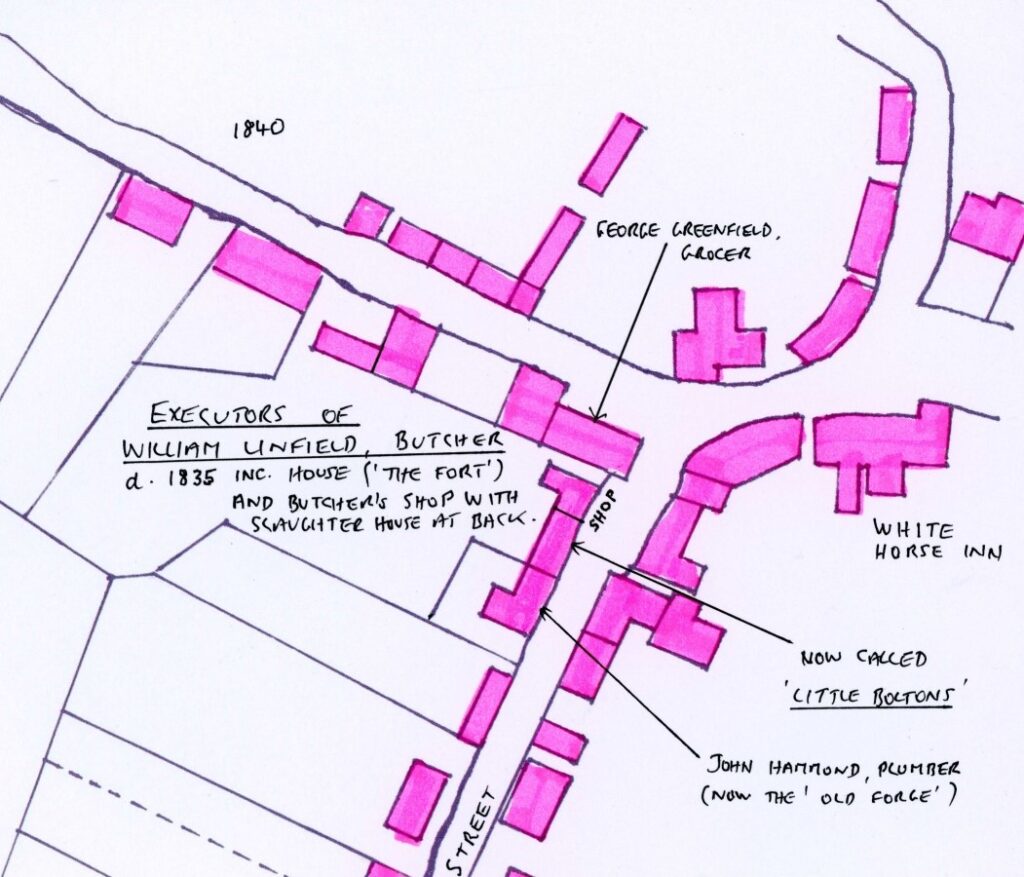
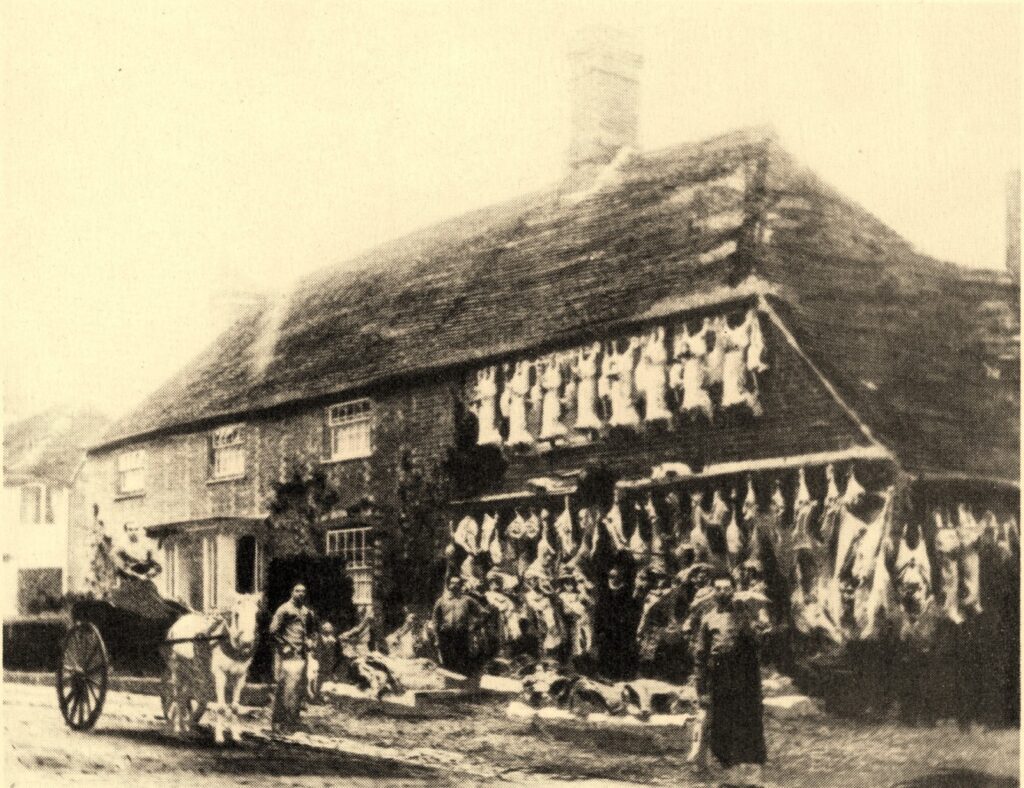
At the age of 34, William married 19-year-old Harriet Stanford at St. Mary’s, Storrington on 14 June 1803 and they proceeded to have a large family of 14 children. Fig 3 shows an early photograph of the front of their house with the butcher’s shop, which was probably taken during the 1870s when Maurice Towse had it. According to Stanford, Harriet’s mother refused to attend the wedding (perhaps she disapproved of the age gap?) Sadly, both William and Harriet died in 1835, leaving two orphaned children below the age of 10. These were their children, born between 1803 and 1829:
(1). WILLIAM LINFIELD, baptised at Storrington on 28 October 1803.
William married Ann Nash at Storrington on 19 January 1830, but there were no children. By 1841, he was a maltster in the village and owned the freehold of a malthouse in Back Lane. He owned the building until at least the mid-1850s before selling it sometime prior to the 1861 census, when his occupation is simply recorded as ‘Gardener’. William was also in a business partnership with his younger brother Henry for many years, farming the land which had previously been in the hands of their father, William (1769-1835). Evidence the brothers provided at enclosure proceedings in 1851 shows that their father took Hurston Street Farm and the adjoining Perretts Farm in 1816 and continued with sheep. The previous tenant, Samuel Heather had destroyed the old rabbit warren on Hurston Street Farm and converted it to pasture to support a very large flock of sheep. In the Land Tax Assessments of 1831, William senior was in occupation of Perretts Farm, but it seems that the house was used to accommodate two of his labourers. However, the partnership was dissolved in 1845 and the brothers went their separate ways. William continued his business as a maltster, although in the 1851 census he describes himself as a ‘Land Proprietor’.
A long-running family feud with his uncle Edward (1774-1861), his father’s younger brother, led to a serious altercation in 1842 when William came off considerably worse. What it was all about is a matter of conjecture and may have had something to do with an old dispute between Edward and his older brother William, who had died in 1835. The incident was reported in the Brighton Gazette of 29 December 1842, among a list of cases dealt with at the Petty Sessions at Petworth on Saturday, 17 December:
William Linfield v. Edward Linfield. Owing to the circumstance of there being a lawyer “retained” for each party in this case, and consequently of there being, to use a vulgar expression, “more jaw than law,” the Court was engaged for upwards of an hour in an effort to ascertain whether the complainant, or the defendant, his uncle, between whom there seemed to exist an old family feud, struck the first blow in a quarrel which took place between them, on the day of Storrington fair, when the complainant received a blow from the defendant which, to use his own phraseology, “broke the bridge of his nose, blacked both eyes, and left him so that didn’t know whether he should die or not, for nearly a week.”—Defendant was fined in the nominal penalty of 1s. and costs.
Edward lived in the neighbouring parish of Sullington and in the 1841 and 1851 censuses is described as a gardener, where he had a market garden in Water Lane on what is now a part of the playing fields belonging to the school (formerly Rydon School, now part of Steyning Grammar School). Edward and his wife Hannah, were living in a copyhold property of the manor of Thakeham situated on the east side of Water Lane, close to the crossroads. They had inherited the property from Hannah’s father, Thomas Hayler. The Sullington Land Tax Assessments show that sometime between 1825-30, they had built a house on the property, which no longer stands. Their son Peter took over the business during his father’s later years; interestingly, there is a scathing assessment of him in the diary of the Rector of Sullington, Canon Henry Palmer:
1861 April 6 (Good Friday)
Went to see Mr and Mrs P. Lindfield and Charles Barnard. The male P is certainly destitute of manners – he looks like a sulking brigand – but asked me to come and look in his garden some day in May.
Perhaps he had inherited some of his charm from his father? But what was their feud all about? It may have been a long-standing property dispute between the two families, but on the other hand, Edward and his family were very much the poor relations and may have felt a gnawing resentment at the considerable discrepancy in wealth between the two branches. Edward and his wife Hannah would undoubtedly have struggled to support twelve children. The 1841 tithe map for Sullington shows Edward as occupying his garden and cottage, 3 acres 1 rood 1 perch (185) at the Water Lane crossroads, whereas his nephews William and Henry occupied 374 acres of arable, pasture, meadows, farm houses and other buildings belonging to George Wyndham, for which they paid £80 in rent. William also owned his malthouse in Storrington, whilst Henry and his family lived in the spacious Hurston Street farmhouse. Edward and his family undoubtedly experienced much harder lives during which they would have struggled at times and he could well have had a grudge against his brother’s family. Perhaps a thoughtless or provocative remark was the catalyst for William’s broken nose and black eyes on that fateful day at the Storrington fair!
In an article from 1993,6 Eric Linfield raises another important consideration: in the Sullington parish register for 1812, when his son James is baptised, Edward is described as ‘butcher, of Storrington’. Had he been working for his brother, William and there was a fall out which resulted in him having to find another job? Perhaps the business wasn’t large enough to support two families. Whatever the reasons, there was definitely some sort of family feud for which there had to be a reason.
Stanford Smith says little about the younger William, although his claim that he died in 1854 is completely wrong. In fact, William and Ann are still living in Storrington at the time of the 1861 census; now described as a ‘gardener’, William appears to have fallen on hard times. During the 1860s, William and Ann decide to leave the village and move to Bexley Heath in Kent. William died in 1869 and in the 1871 census, his widow Ann has taken in a lodger at her house in Elizabeth Terrace, East Street. Ann died on 24 March 1889 at the age of 82 and was buried at the Bexley Heath cemetery.
(2). HENRY LINFIELD, baptised at Storrington on 17 February 1805
As mentioned above, Henry was a farmer in partnership with his brother William until the it was dissolved in 1845. According to Stanford Smith, their younger brother Peter Stanford Linfield was also in this partnership until 1831. Henry married three times, his first to Lucy Matthews at Thakeham in 1829 by whom he had six children. Lucy died in 1843, possibly in childbirth. He then married Matha Neal in 1844 and had a son, John born in 1845. She died the following year, and it is a distinct possibly that it was also during childbirth as it was such a major cause of death among women at the time. Henry married his third wife, Maria Frances Peskett in 1847 and they had a son Edward, born in 1848.
In the 1851 Census, Henry is shown as living at Hurston Street Farm consisting of 250 acres with 12 employees working the land. However, what the census does not reveal is that Henry’s farming business was already failing: at the Petty Session of March 29 1851, a distress warrant was granted against him for non-payment of £9 3s 10.5d poor rate to the parish of Storrington.7 On April 5 1851, Henry was summoned for non-payment of £3 1s 6d church rates.8 He did not appear and the Magistrates ordered payment. Henry did not have the resources to pay these rates and was effectively insolvent. At the County Court in May 1851, Henry’s brother, Peter Stanford Linfield, a farmer at Cocking, asserted a right to all the property on his brother’s farm by virtue of a bill of sale for £1076 18s.9 However, as Henry was insolvent when he signed the bill of sale, the Judge gave judgment against the claimant as it would reduce him to the status of insolvent debtor who had shown preference to one creditor over the others. Therefore, the Judge recommended that the solicitors and body of creditors should retire to consult, and eventually it was agreed that his brother Peter Linfield, Mr T. Carter, Mr. T. Challen and Mr West, act as Trustees ‘to make the most of the property’.
Stanford Smith claims that Henry died in 1848 and was ‘buried in Storrington Churchyard although there is no entry of his death in the Parish Register’. He continues:
Of Henry’s sons the descendants of John only can be traced. The eldest after his father’s death worked for his grandfather Leonard Matthews of Brickkiln Farm, Shipley; the eldest daughter Ellen also lived with her grandfather. John and Ann only are mentioned in the will of Peter Stanford Linfield’s widow in 1882, and as the legacies were only £200 each and the amount of the estate was worth £22,000 it looks as if these were the only surviving offspring.
Unfortunately, his conclusions are again incorrect. Not surprisingly, Stanford Smith would have had enormous difficulty finding out what really happened to Henry and his family. Henry certainly didn’t die in 1848, as he claims, which he would have discovered from the 1851 census for Storrington, but for some reason he failed to miss this important detail. However, in this instance, he could have found this record quite easily. He was having some fairly challenging problems with his eyesight during the 1950s so whether this had an impact on his ability to read the records accurately is quite possible.
Soon after his insolvency, the family left Hurston Street Farm and took their young children well away from Sussex to start a new life. This included their 4-year-old son, Edward and at least one of his other children, Leonard (10). They moved to Lincolnshire where Henry found a job working for one of the railway companies. The 1861 Census shows him and Frances living at Firsby in Lincolnshire, where his occupation is given as ‘Gate Keeper G.N.R’. He is now 57; their son Edward is still living with them, but Leonard has now left home. By 1871, Leonard is working as a railway porter, living in Boston, Lincolnshire with his wife Caroline (Strudwick) whom he married in 1870. John went to live with Ann Neale, his mother’s unmarried sister, in Midhurst where he was apprenticed to a grocer. In 1869, he married Emma Coombes and they settled at Hartley Wintney in Hampshire where John was employed as a grocer and draper’s commercial traveller. They had a large family of 8 children, of whom 7 were daughters.
In 1881, now aged 76 and living with Maria in the village of Saxelby with Ingelby, Henry is still working as a Gate Keeper. However, soon after he retired from his job and they moved to Finchley, presumably to be near their son Edward and his family, who lived in Vernon Terrace. Edward had married Lydia Fosdike in 1876 and was employed as a warehouseman at a tie depot. Henry died in August 1886 at the age of 81 and the 1891 census shows his widow was living with their son’s family. They now had two children, John H. Linfield and Edward junior. Edward’s half-sister Anne Linfield, 46 is shown as a visitor. Maria Linfield died in 1898, in her 89th year. Edward died in 1901 at the relatively young age of 53.
(3). PETER STANFORD LINFIELD, baptised at Storrington on 1 October 1806
Stanford Smith says the following about him:
Peter Stanford Linfield 1806-1874 was in partnership with his brothers William and Henry till 1831, then he has farms in Treyford and Cocking. He described himself as a farmer, miller and maltster. He was the most successful of the Linfields. His estate was about £22,000, half of which he settled on his wife. Much of his money was made by shrewd buying of stocks and shares.
He married Elizabeth Marshall at Bignor, Sussex on 2 November 1830. Her brother William Henry Marshall was the miller in Storrington at the time, though he eventually returns with his family to Bignor in the 1840s to take over Bignor Mill. Peter and Elizabeth initially went to live in the town of Midhurst, and in the 1841 census he is described as a farmer. In 1851, they were living in the parish of Cocking, three miles south of Midhurst, on the Chichester Road, and Peter’s occupation is given as ‘maltster’. They have two servants, one male and one female. We know from his County Court appearance in May 1851, when he tried to obtain control of his brother Henry’s farm in Storrington, that he was also described as a farmer.
By 1859, Peter and Elizabeth had moved to Portsea Island, taking a property at Mile End near the docks. He is described in a local directory as ‘Gentleman’; presumably, he has retired from his earlier businesses as a farmer and maltster. In the 1861 census, he is described as ‘gentleman, retired stay-maker’ which adds another intriguing aspect to his business interests. Perhaps he was supplying corsets to his two brothers Mark and Stanford on the Isle of Wight, both of whom were drapers on the island! However, I wonder whether this is a mistake on the census – as it looks as though the term has been inserted by a different hand and there is no other evidence to confirm it. However, he probably maintained his family connections with his younger brothers, since he left a generous inheritance which they received in the will of his widow after she died in 1882. By 1862, Peter and his wife are living at Marston Lodge, Elm Grove in Southsea; however, by 1867 they have left the area and moved to 10, Canonbury Terrace in Islington.
Peter certainly appears to have been a shrewd businessman, taking after his father and grandfather, and his investments in stocks and shares proved particularly astute. When he died at 10 Canonbury Terrace, Islington on 11 August 1874, he left £12,000 of personal estate to his widow Elizabeth (whom Stanford Smith refers to as ‘Aunt Betsy). At her death in 1882, her personal estate was valued at over £22,000, showing a significant accumulation in her wealth. They remained a childless couple, and in her will she bequeathed generous sums to favourite nieces and nieces, as well as a great-niece, and many of her husband’s relatives, in particular his surviving siblings Thomas, Mark, Stanford, Mary Stanford Braby and Emily Hobden. To her nephew, Harry Stewart, son of her sister Phillis, she gave ‘my dear husband’s gold watch’.
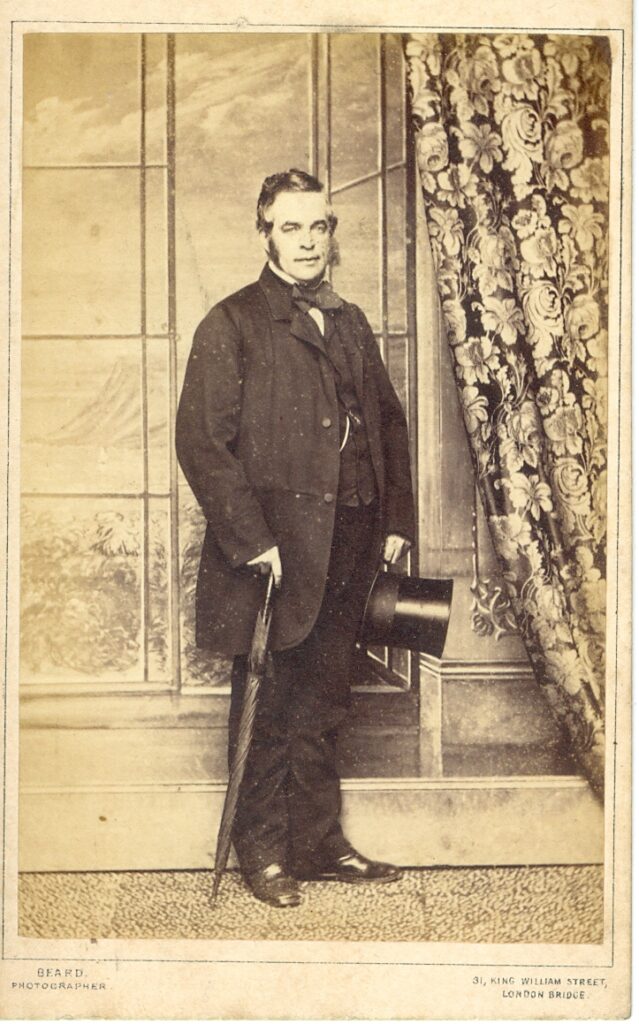
Kath Bennett, a direct descendant of Mark Linfield, has a photograph in her collection which I now believe may depict Peter Stanford Linfield. It shows a very smart gentleman, aged about 60, and was taken at the studio of Richard Beard at 31, King William Street, London Bridge. Beard left this location in 1866, but we also know that Peter and Elizabeth moved to Islington at around this time, which was not that far from the studio. So it is certainly feasible that it could be him – we know he probably kept in touch with his younger brother Mark, and so he might well have sent him this photograph after they moved. And there is also a further question – why else would Mark have had this photo in his possession?
(4). MARY STANFORD LINFIELD, baptised at Storrington on 10 July 1808
Mary married Thomas Turner, general labourer, at St. Mary’s Church on 17 March 1831 when she was 23 years old. They went to live at the neighbouring hamlet of Cootham, just a mile or so to the west of Storrington. They had five children together, Harriet (1832), Eliza (1833), Martha (1835), William (1837-40) and Stanford (1841). Sadly, after just 11 years of marriage, her husband died in 1842 at the age of 35. She moved back to Storrington and in order to generate an income, she took up needlework and also took in lodgers. In the meantime, her three daughters found work locally as domestic servants.
On 1 October 1853, she married Edward Braby, a widower, in the parish church. Edward was twelve years older than Mary; he worked as a cordwainer and later made shoes. Edward died at the age of 80 in 1875.
Of Mary and Thomas’s children, Eliza married Mark Albery in 1866 and went to live in Market Square, Horsham. Mark had a stationer’s and newsagent’s shop in Horsham and was the uncle of well-known saddler and local historian William Albery, son of his younger brother William. Their daughter Martha married her cousin Thomas Linfield on 20 December 1864 in Storrington. Thomas was the son of Mary’s younger brother, Thomas (1812-84) who was a butcher in the village. Harriet married Thomas Stevens at Henfield in 1865; Thomas was a watchmaker and they later moved to West Tarring and Worthing.
Mary undoubtedly would have been pleased to receive a generous legacy when her sister-in-law died in 1882. Elizabeth Linfield was the widow of her brother Peter, and left her £500. But Mary died the following year, so presumably had little time to enjoy her money. She left personal estate of £399-16s-9d.
(5). RICHARD LINFIELD, baptised at Storrington 2 May 1810
Sadly, Richard died at the age of 3, and was buried in the graveyard at St. Mary’s Church, Storrington on 15 August 1813.
(6). THOMAS LINFIELD, baptised at Storrington 1 June 1812 (born 8 May 1812).
Stanford Smith says the following about his great-uncle Thomas:
Thomas Linfield 1812-1884 was a cricket ‘fan’. He belonged to the Storrington Cricket Club, the only local club that beat the County Club. For this reason he chose an occupation that would allow him his summers free, and in which he only need work during the autumn and winter. He worked as a pork butcher. In those days people did not eat pork in the summer’.10 In later life he acted as umpire in matches all over Sussex. His business did indeed just keep him all the year round but left him nothing to spend on the education of his children who were turned out to work at the age of twelve. None of his sons were men of character. John became a general handyman, Luke that and a carpenter with the result that the Storrington Linfields, descendants of Thomas, sank to the level of cottage folk, except some of the girls who, being good-lookers, married comparatively well.
Thomas married Sarah Carpenter at Amberley in 1836. As a butcher, he probably learnt the trade from his father and may still have been working for him up until the time of his death in 1835. In his will, made after the death of his wife Harriet earlier in the year, William stipulated that he wanted the profits from his business in Church Street, as well as his real and personal estate, to be managed by his executors (who include his eldest two sons, William and Henry) to finance the upbringing, maintenance and education of all his children still under the age of 24 years from the time of his decease. His youngest child, Stanford Frederick, who was only 6 when both his parents died, was excluded from this settlement. Once his youngest child before Stanford (Mark Linfield, born in 1825) reached 24 years of age, then all his property was to be sold and the sum raised invested in securities to pay for Stanford’s upbringing and education until the age of 24.
Mark became 24 in 1849, which prompted the sale of his ‘dwellinghouse, garden, buildings and premises now occupied by me and the little field in Clay Lane in Storrington’ (bought for £250 from Mr William Dennett). His butcher’s business and properties were to be offered in turn to each of his eldest four sons, starting with William, then Henry, Peter Stanford and finally Thomas, in priority of age, including the butchering tackle and the fixtures in the house, and the field in Clay Lane for £350. However, if none of his named sons wished to purchase the business and real estate, then the whole was to be sold and disposed of accordingly by his executors to raise the necessary funds to fulfill William’s last wishes.
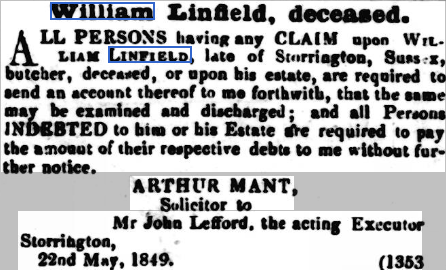
The executors had quite an onerous task as the requirement of William’s will was to keep the butchers’ business and farms going until 1849. William and Henry were both busy men in their own right, with their own business interests to pursue, so the only option open to them was to find someone to run the butcher’s shop in Church Street on behalf of the executors. The natural choice would have been Thomas, but Stanford Smith seems to think that his younger brother, George (born in 1816) took over the business. This actually makes sense because George was also a butcher by trade and from at least 1839 (Pigot’s Directory of Sussex), Thomas and his family were living in Billingshurst where he had a butcher’s shop next to the King’s Arms. However, George died unexpectedly in August 1841 at the age of 25 from tuberculosis, leaving the problem of finding a replacement. It may just have been a coincidence, but soon after Thomas and his family returned to live in Storrington (based on the baptism in St. Mary’s Church of their son, John in May 1842), which begs the question as to whether his brothers approached him to assume control of the family business after George’s death.
If this was the case, Thomas presumably continued to run the business until 1849, when the time came for the four brothers to decide whether any of them wished to go ahead and purchase it from the estate. All of them refused, so it was put up for sale with the family home, shop and slaughterhouse at the rear. The house and business in Church Street were sold to Maurice Towse who moved into the house with his family, and continued to run the business until his death in 1888. Thomas was now free of his obligation and established his pork butcher’s shop at different premises in Church Street, enabling him to work only in winter, play cricket in summer and when too old, go about the county as umpire in local matches.
By 1881, Thomas had retired and he and Sarah were living with their son Luke and his family in East Street. Stanford claims he ‘suffered from senile decay a year or two before his death’ and his business had suffered in its later years as he allowed people to run up debts and when he died ‘he left a lot of IOUs but little else.’ Not exactly, as he benefited from the will of his sister-in-law Elizabeth, widow of his brother Peter, who left him £500 in 1882.
There are a number of photographs at Storrington Museum of some of the early cricket teams in the mid-19th century, so it is likely that Thomas may be in one of them. Certainly, his son John features in a couple, well-known in the annals of the club for the time he captained the celebrated team which defeated W. Hammond’s XI on 17th January 1867 – the match having taken place on the frozen village pond! His team won by 112 to 89.
(7). JOHN LINFIELD, baptised at Storrington on Nov. 30 1814 with his twin sister, Anne Linfield.
Unfortunately, we have very few details of John in the records. He never married and died when only 20 in 1835. He outlived his mother Harriet by just a few weeks, and was buried in St. Mary’s churchyard on April 14 1835 (his mother was buried on March 25). His father William died in December at the age of 66. There is no indication as to whether any of these deaths were connected, but the close proximity of John’s death to his mother’s may have been the result of tuberculosis in the family home, a scourge during the 19th century.
(8). ANNE LINFIELD, baptised at Storrington on Nov. 30 1814, with her twin brother, John Linfield.
Interestingly, Stanford Smith has quite a lot to say about Anne in his note book. This is the full transcript:
Ann Linfield (Mrs. Morton)1814-1850, was the beauty of the family. She became engaged to a young medical officer in the East India Co’s service. When he learnt that her capital amounted to £100 with a small reversion when her father’s estate was to be wound up in 1849 he jilted her with businesslike promptness. Ann then became engaged to and married another East Indian Medical Officer considerably older, Col. John Morton. He went to India again as Medical Superintendent of Madras, accompanied by his wife. There Ann found the man who had thrown her over was a junior assistant to her husband. An embarrassing situation perhaps as possibly Ann used her influence to make him smart for his infidelity. In Storrington at that time there was a ‘college’ for candidates for the services – in reality a kind of crammer. Doubtless both Ann’s suitors found employment of a temporary nature while on leave. This would explain how a girl in a remote Sussex village was able to pick and choose among young East Indian officials.
Anne married Colonel John Morton, widower on 17 April 1838 in St. Mary’s Church at Storrington. John was born in 1796 so there was a considerable age gap of 18 years. On the marriage certificate, John is recorded as the son of Selby Morton, Farmer, and Anne the daughter of the late William Linfield, Butcher. Her elder brother William and sister Emily are both witnesses. According to Stanford, they had several children, all born in India, except the final two, Andrew Stanford Morton (1849-1927) and James Campbell Morton (1850-1920) who were born in Northam, Devon after John Morton retired and the family came back to live in England. Sadly, Anne died in the first quarter of 1851 at the age of 37, leaving behind two very young children. Her widower John married for a third time, in 1858, and although by now in his sixties, fathered two more children, Emily and Charles Alexander. He died in 1866.
Incidentally, Stanford makes the assumption that Anne met her Colonel through the ‘College’, a type of high-class crammer set up in Church Street for boys wishing to enter the military, and that John Morton was there for a while to do some temporary teaching. Quite a plausible theory as to how ‘a girl in a remote Sussex village was able to pick and choose among young East Indian officials’, but it never happened because the ‘College’ wasn’t established until 1871. However, what I have managed to discover is that John’s brother James Morton (whose name appears as a witness on their marriage certificate) was the Steward at Parham House, the Elizabethan mansion to the west of Storrington and owned by Robert Curzon at that time. James was there from at least 1833, and lived with his wife Helen at Cootham where they occupied a house with garden, orchard, and a two-acre field of pasture belonging to his employer. John may have come to spend some time with his brother, perhaps soon after the death of his first wife in India, and this gave him the opportunity to meet Anne Linfield. Perhaps she worked in his brother’s household or at Parham House, but somehow their paths crossed and they obviously fell for each other.
Their son Andrew Stanford Morton became a distinguished ophthalmologist at University College, London, and Moorfields Eye Hospital, and his main claim to fame was his ‘improved student’s ophthalmoscope’ which he introduced in 1884. Although it still relied on an external source of illumination, his compact model also incorporated a series of 29 separate lenses propelled by a driving wheel. It was easier to use and improved the detail which could be seen. His ‘Morton ophthalmoscope’ was a popular model for over 40 years.
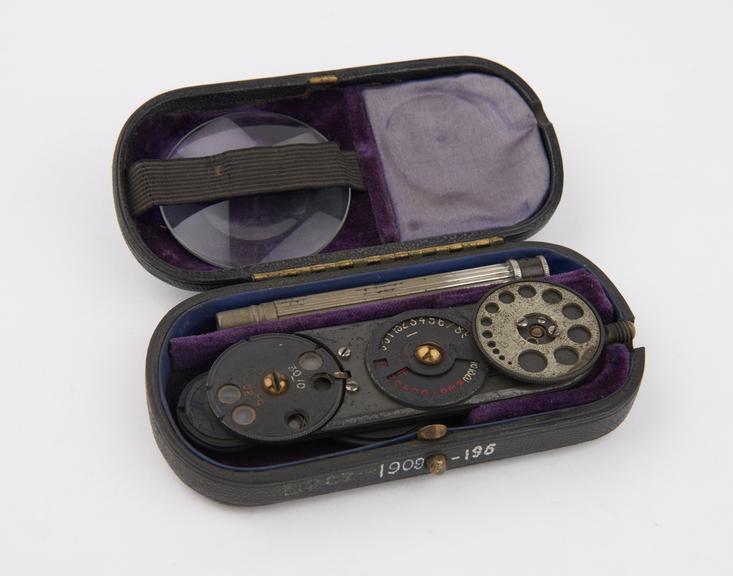
Morton practised at 133 Harley Street. After his retirement in 1920, he went to live near relatives at Clifton, with his younger brother James with whom he had shared a house in London since the 1880s. Neither married; James was a man ‘of private means’ who died in 1920. Andrew died on 11 April 1927. Interestingly, in one of his letters, Stanford Smith reveals that the only Mortons he knew were Andrew Stanford, James Campbell and their sister Anne (Mrs Stancomb). He says : ‘Campbell was rather an old woman, when I met him he was prematurely aged and whose hobby was making out his own prescriptions which his brother Stanford with whom he lived tore up regularly’.
Stanford also writes about him in his notebook:
Andrew Stanford Morton 1847-1927, one of the leading oculists of his day. He was a very conscientious surgeon. Although a Plymouth Brother, and of very pronounced religious principles, he was not in the least narrow minded but sympathetic and of charming personality. In appearance tall, spare, aquiline nose, deep set eyes with a gentle expression, and a short beard. His invention, the Morton Ophthalmoscope, now the Morton-Lister Ophthalmoscope, a most ingenious and complicated instrument for examining the back of the eye, has never been superseded and is still in use. He retired to Bristol to the house of his sister, Mrs. Stancomb, the widow of a West India merchant, where he died.
Charles Alexander Morton (1860-1929) MRCS became a renowned surgeon in his own right, with a long and illustrious career. His work as a surgical teacher began in 1897 when he was appointed Professor of Systematic Surgery in University College, Bristol, a position he held until 1925, when he resigned and was made Emeritus Professor in the University of Bristol.
(9). GEORGE LINFIELD, baptised at Storrington on 16 July 1816.
George followed in his father’s trade as a butcher, and according to Stanford Smith, it was George who was asked to carry on the family business in Church Street after his father’s death in December 1835. As mentioned earlier, it was stated in his father’s will that the family business should be continued until his son Mark reached the age of 24 in 1849, with all profits to be paid out for the education and upbringing of all his children under 24 years at the time of his death. The sale of all his property in 1849 was to be used to support the education and upbringing of his youngest son, Stanford who was only 6 when both his parents died.
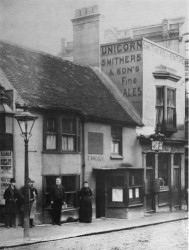
Checking the 1841 census for Storrington, I expected to find George living at the family house in Church Street on the night it was taken, with some of his younger siblings, but he wasn’t actually there. His sister Jane and brother Stanford, as well as his niece Hannah Linfield, son of brother Thomas, are all there as well as his butcher’s apprentice, Albert Lee. So where was he? In fact, on the night of the census, which took place on June 6, George was staying at the Unicorn Inn in North Street, Brighton (Fig. 8). His age is given as 25 and his occupation as butcher. The names of his companions and the date are of significance in trying to explain the reason for him being there. June 6 1841 was the first day of the Sussex County cricket match against Kent at the Royal New Ground, and his companions are some of the Sussex cricketers selected to play in the team, which included George Millyard, farmer, 25; Mortimer Ewen, farmer, 20; Charles Hawkins, hairdresser, 20; and Charles Hammond, painter, 20. Frederick Haslett, woolstapler, 25 is also there, another Sussex player, although he doesn’t seem to have been selected for this particular match.
Like his brother Thomas, George was probably very keen on cricket and may have played himself, although there is no evidence suggesting he was there in the capacity of a reserve player. However, Charles Hammond lived next door to the Linfields in Church Street, where his father John had his business as a plumber, glazier and painter in the building now known as the Old Forge. The Hammonds were well-known Storrington cricketers, and John had played first class cricket himself between 1790 and 1816. George and Charles would have known each other all their lives and as this was a very special occasion for Charles, who was making his first-class debut for Sussex, George was probably there to accompany his friend and give him encouragement and support. No doubt, Charles was grateful to have his friend with him and George was excited to be there to enjoy the game and watch his friend perform.
The first day of the match was on Sunday 6 June (Kent first innings, 66/4) and the second day on Monday 7 June, Sussex second innings 47. Charles played first class cricket for 13 years, making a total of forty appearances. Renowned for his big hitting as a batsman, however, he was not the best of fielders which meant he was not always picked for the more important matches.
However, this match was to be one of the last games George ever watched. Sadly, he died only two months later at the age of 25 from consumption, and was buried in the churchyard of St. Mary’s, Storrington on 24 August 1841. This left a problem for the executors of his father’s will as they had to find a replacement to run the old family business in Church Street. As described earlier, it was thought that George’s death may have precipitated the return of his brother Thomas from Billingshurst to take over the butcher’s shop to fulfil the requirements of their father’s will.
10). EMILY LINFIELD, baptised at Storrington on 22 July 1819.
Emily was the grandmother of Harry Stanford Smith. As would be expected, he knew quite a bit about her, which is revealed in his notebook. This is what he has to say:
Emily Linfield (Mrs John Hobden) 1819-1897. Born at Storrington; her parents died in 1835. Her elder sister Anne married in 1838 after which Emily ran the house in Storrington as a home for her younger brothers and sisters. Later she taught in the school, Bine Villa Ladies School, run by her cousin Anne Hughes. Some when before 1850 she went to Uckfield as companion to an elderly couple called Kenward. In Jan. 1855 she married John Hobden and on Nov 2nd 1855 her only child Emily Harriet, my mother was born. Her husband died in 1856 and left her very badly provided for. She took a smaller house, Olive Lodge, High St., Uckfield, the lower portion of which is today the office of a building society. Here she tried to establish a school for quite young children but without much success. She built up a connection, mainly with officials in India, to look after their quite young children, but after 1874/5 when the Suez route to India was in being, this connection languished. However by this time her daughter was working in Butts Croft as a pupil teacher, also Emily’s brother Peter Stanford Linfield, and later his widow helped her.
In 1886, after the marriage of her daughter, she went to live in her son-in-law’s house in Brighton till her death in 1897. For some ten years previously, she had suffered from Parkinson’s disease (creeping paralysis). Since 1882, when she was bequeathed substantial legacies under the will of Elizabeth Linfield, Peter Linfield’s widow, she was more comfortably circumstanced. She was a strong character, somewhat reserved, and of sound common sense. In fact, she was often consulted by members of her family on their financial concerns. She was an executrix to the wills of her brothers, Mark and Stanford Linfield, and of the latter’s widow, Elizabeth Linfield nee Steward.11 Although strict and rather rigid in outlook, she was a kindly soul, and of an unassuming natural dignity, inherited by her daughter. She is buried in the Extra Mural Cemetery, Brighton, in her daughter’s grave.
Interestingly, in the 1841 census, Emily is living in Arundel at the house of Thomas Fry, a merchant in High Street. No occupation is given, but there are young children in the family so she was probably taken on to look after them. As Stanford intimates, she may have looked after her younger siblings at the family home in Church Street, Storrington after her sister Ann married John Morton in 1838, but probably for only a year or so until her younger sister Jane was old enough to resume this responsibility. Jane was, in fact, 18 years old in 1841. Mark Linfield, who was now 15, had in fact already left the family home because he is living in Steyning as a draper’s apprentice at the house of Henry Marshall. His older brothers, William and Henry, as executors of their father’s will, must have been keen to lighten the financial burden of supporting the younger members of the family by getting them out to work as soon as possible.
On 13 January 1855, Emily married John Hobden who was born in Lewes on 1st October 1812, where he worked as a solicitor’s clerk. John married his first wife, Eliza Levett, on 25 September 1834 at St John’s Church, Southover and they had six children. By 1851 the family had moved to Uckfield, ten miles to the north of Lewes, and settled in their new home at Milton Cottage, in Church Street. Sadly, Eliza died in Uckfield on 21st December 1853, aged 46.
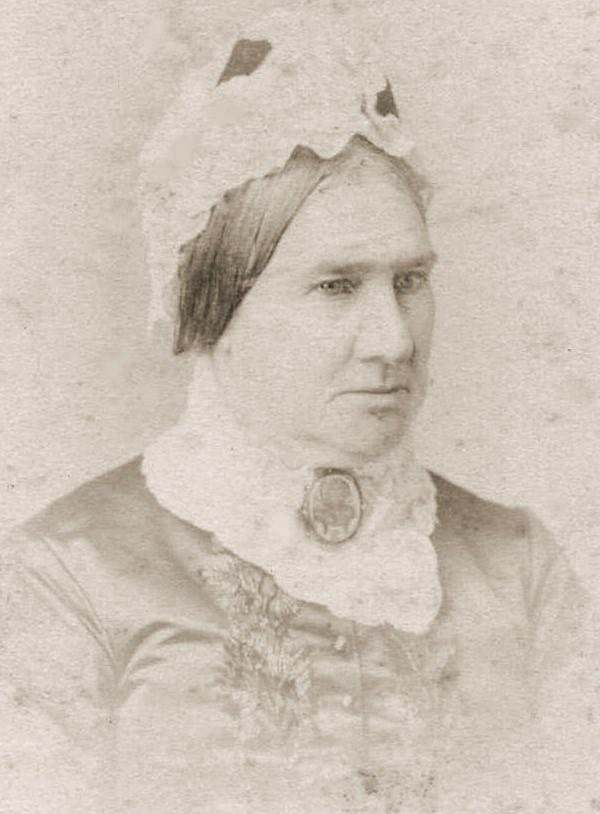
According to Stanford Smith, John Hobden, his grandfather,
was: . . . a somewhat austere man, sincerely pious and upright, kindly and warm hearted which he concealed behind a formal exterior. In speech he was somewhat stilted and perhaps pompous. When sending his son Inigo the present of a silver pencil
he said in his letter he hoped ‘that it will meet with your approbation’. Such formality of address was partly the prevailing fashion of his period and still
more of his profession. He was a man of integrity and considerable culture who complimented his sons’ education by contributions from his own not inconsiderable store of learning.
John was 42 years old when he married Emily Linfield, and they had one child together, Emily Harriet Hobden, Stanford’s mother, who was born in Uckfield on 6th November 1855. Her father died just after her first birthday, on 10th November 1856, aged just 44. Apparently, he caught a chill after a game of cricket, which presumably made him vulnerable to the tuberculosis which eventually killed him. Emily was brought up by her mother at Olive Lodge, a more modest property to which they moved after his death. She lived with her mother until she married 25-year-old auctioneer Harry Smith at Brighton on 5 June 1886. The family auctioneer business was started in Uckfield by Harry’s older brother, George St. John Smith. In 1882, Harry joined his brother as a partner, opening an office in Brighton, but in 1885, the partnership was dissolved and Harry continued on his own account at Brighton.

After her daughter’s marriage, Emily went to live with them at Brighton. Their first child, of course, was Harry Stanford Smith who was born at the family home, 71 Ship Street, on 14 May 1887 which was above his father’s business premises. Stanford also writes a short biography about his mother, whose premature death in 1913 at the age of 58, appears to have affected him quite badly. Reading the following excerpt leaves the distinct impression that he never really forgave his father for the circumstances which must have hastened her death:
Emily Harriet Hobden, Mrs Harry Smith (1855-1913) was one of the dearest of women, a wonderful wife and mother. Outstandingly unselfish, affectionate, sympathetic, intelligent, wise and tactful. She kept the family together in spite of the asperities of a difficult and unusually temperamental husband. Her real goodness was widely recognized. Persons outside her family circle came to her for sympathy and counsel. She suffered ill health all her life with recurrent attacks of migraine which laid her up for 3 and 4 days at a time. In 1913 she had an operation for appendicitis which was unnecessary as the appendix proved to be healthy. Her husband sent her to Broadstairs to recuperate in lodgings reached by 5 flights of stairs. The resultant strain in her enfeebled state brought on heart trouble followed by other complications. Her death was a real tragedy and caused much havoc in her family felt by her children for many years afterwards. She is buried in the Extra Mural Cemetery, Brighton. Born at Milton Cottage, Church St., Uckfield, lived from 1856 till her marriage at Miss Bennett’s, Butts Croft, Uckfield, where she was later a pupil teacher.
11). JANE LINFIELD, baptised at Storrington on 9 May 1823
As mentioned earlier, in 1841, at the age of 18, Jane was living at the old family home in Church Street, Storrington looking after her younger sibling Stanford, aged 12, and her niece Hannah, aged 4, her brother Thomas’s daughter. Since the death of her parents, William and Harriet Linfield, in 1835 it looks as though Jane took over this role from her sister Emily after she left to go and live in Arundel. By 1851, she has moved with her two younger brothers, Mark and Stanford to 1, Albert Terrace, Camberwell where she is recorded in the census as their housekeeper. Mark and Stanford were in business together as linen drapers, although Mark was soon to get married and in 1854 moved to Ventnor on the Isle of Wight. Stanford was still living at Camberwell until his marriage to Phoebe Pickerden in April 1854 at Hastings. He too soon left and went to live at Brading on the Isle of Wight, both brothers setting up as drapers on the island.
Jane continued to live at the house in Camberwell, presumably taking over her brothers’ business as she is recorded as a draper in the 1861 census. Her niece, Eliza Turner, daughter of her sister Mary Stanford Linfield (who married Thomas Turner in 1831) is living with her as her housekeeper. Jane was already a widow by 1861, having married James Brown at Deptford in 1857 but he died soon after. In 1863, she married John Livingston, widower and gentleman, in the parish church of Hatcham in the county of Kent. In 1871, they were living at Grove Villas in East Ham with John’s 18-year-old daughter, Jane. John’s occupation is recorded as ‘Traveller for Brewer’s’.
Jane died in 1878 and was buried at the City of London and Tower Hamlets Cemetery on 5 July, at the age of 55.
12). MARK LINFIELD, baptised (privately) at Storrington on 6 June 1825.
As mentioned earlier, by 1841, at the age of 15, Mark is working as an apprentice to Henry Marshall, draper of High Street, Steyning. Sometime after the completion of his apprenticeship, Mark moved to Camberwell, setting up in business with his younger brother, Stanford. On 29 September 1851, he married Mabel Hall at Belper in Derbyshire, returning with his bride to Albert Terrace to live with his brother, Stanford and sister Jane. On 10 November 1852, Mark junior was born and it seems likely that the arrival of their first child precipitated their decision to move to a place of their own. Their daughter Mabel, was born on 18 January 1854 at their new home in Islington.
However, later in the same year, they decided to embark on a completely new chapter in their life by moving to Ventnor on the Isle of Wight. As an expanding tourist destination, its attraction to Mark as somewhere to locate his business and raise his family was obvious. Mark worked hard and made a real success of his business, and his family continued to grow. They had a typically large Victorian family, a total of eleven children born between 1852 and 1865, seven sons and four daughters. I have written extensively about Mark and his family before, so I do not intend to repeat any more here. Please refer to my previous articles for further information: ‘The Isle of Wight Linfields – Discovery of an Old Family Album’ and ‘The Isle of Wight Linfields’.
However, Stanford Smith adds some interesting comments about Mark and his family which reveal information not known before. Obviously, being so much closer to them in time, he was privy to some of the family gossip which they would rather have been kept private. His perspective on the fatal road accident which killed Mark junior in 1882 is shocking, and not something which features at all in the reverential newspaper reports. He says:
Mark Linfield (1825-1909), Apprenticed to a draper, started business 1850 at 1 Albert Tce, Old Kent Rd, Lambeth. In 1854 he started business in Ventnor and retired in 1886. He set up his eldest son, Mark, in Shanklin but it was not a success. Mark jnr drank heavily, a failing of several of the later members of the family. While the worse for drink, driving at night in a gig along the undercliff, Ventnor, he was thrown out and broke his neck.Mark senr. was a quietly spoken, taciturn man. He looked and spoke like a bishop. As a businessman, he was too trusting. He incurred serious losses by helping his son Mark and becoming sleeping partner in a wine merchant’s business. He was fond of riding and often rode to hounds, he was kindly and generous, too generous in fact, and greatly respected.
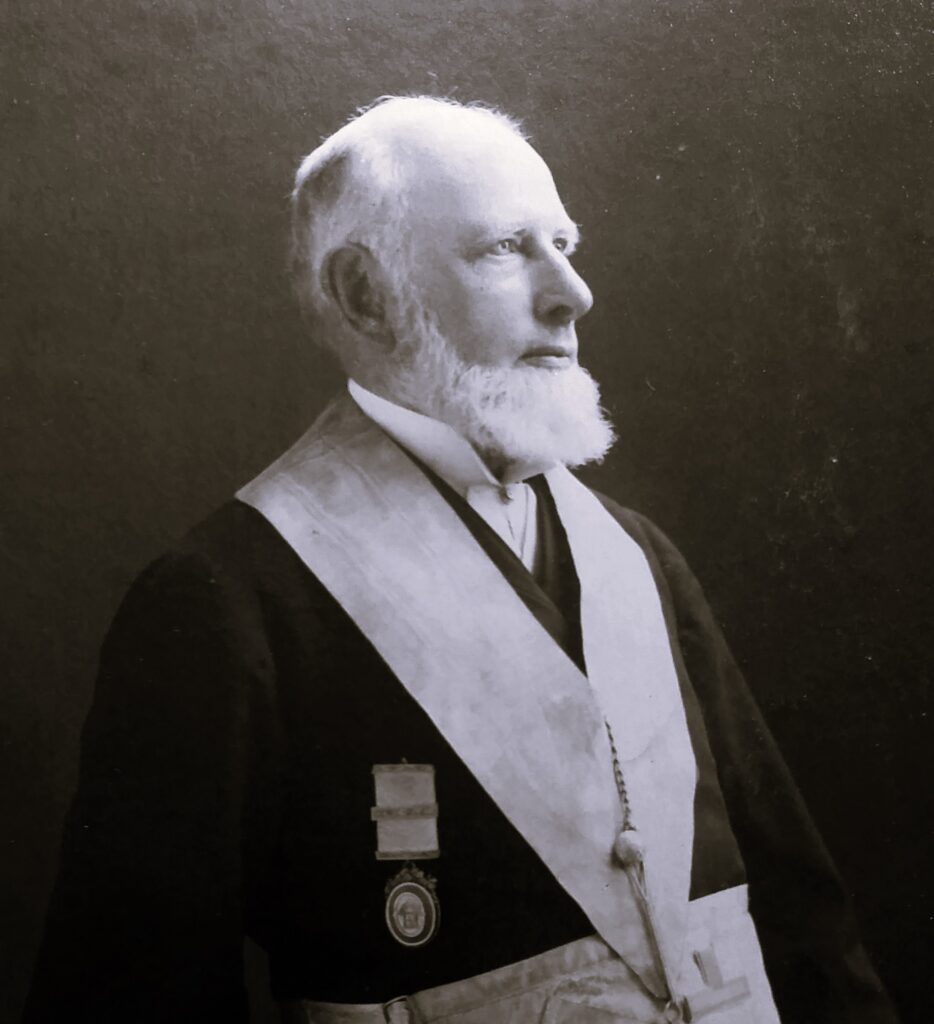
Mark senior was obviously a kind and upstanding member of his community, well-respected and hard working – but too generous for his own good. He was a Freemason, Poor Law Guardian and councillor. Stanford mentions elsewhere in one of his letters that some of his Storrington relatives would occasionally visit him on the Isle of Wight to ‘raise loans from him from time to time’. And certainly, in his photographs, especially in the one shown here where he is wearing his Masonic regalia, there is more than a passing resemblance to a kindly Victorian bishop!
He had his fair share of family tragedies – not only his son Mark being killed in a tragic road accident in 1882, but his second son James had died the previous year from bowel cancer at the age of 25. And then on 15 July 1883, with barely enough time to grieve the loss of his two sons, his wife Mabel died after a long struggle with liver cancer.
Mark was by far the longest lived of the children of William and Harriet Linfield of Storrington. Born in 1825, when he died at Shanklin on 28 March 1909, he was 84 years of age. It seems hard to believe that his father was born in 1769! Another interesting observation is that he when was baptised on 9 June 1825 at St. Mary’s Church, Storrington he was given a private christening – usually an indication that the baby was sickly and not expected to live.
13). STANFORD FREDERICK LINFIELD, baptised at Storrington on 1829
The youngest child, Stanford was only six years old in the year that both his parents died. He continued to live at the family home in Church Street, Storrington, looked after by a succession of older sisters. He may have lived in the property until it was sold in 1849, or at least until a few years before, as in 1851 he is living in Camberwell with his brother Mark and sister Jane. However, after his marriage to Phoebe Pickerden in April 1854, Stanford follows his brother to start a new life on the Isle of Wight, although settling at Brading in the north of the island where he set up in business as a draper. He had two daughters with his first wife, who sadly died in July 1875. Reference to my earlier articles on the Isle of Wight Linfields will provide more detail about Stanford. Stanford Smith says the following about him:
Stanford Frederick Linfield 1829-1889, started business as a draper in Camberwell; later moved to Sandown. He was the handsomest of all his brothers; tall, of very regular features, and of mild expression. He married twice. His second wife was Elizabeth Stewart12. He retired to Newport I.O.W., where he died of cancer. He was moderately successful and left an estate of £10,000 to £12,000.

Stanford Smith is able to provide some interesting, though tragic information about Stanford’s granddaughter Evelyn Isobel Fisk, who was the daughter of his eldest child, Jessie Armitage Linfield (1858-1931); Jessie married Robert Fisk, farmer of Carisbrooke:
Evelyn Isobel Fisk 1900-1947, a thoroughly ‘horsey’ woman. One of the most fearless woman riders in I.O.W. She took many prizes in jumping competitions. Bequeathed some £20,000 by her mother, she became self-willed and capricious and treated her father badly in his old age. She was nevertheless level headed where money was concerned and increased the value of her estate considerably. However she lived a disorderly life and got into bad company. Her health suffered, she had a nervous breakdown and finally committed suicide by hanging herself in a wood at Carisbrooke. She bequeathed the whole of her estate to her maid Lilian Davis who also committed suicide the following day by taking poison. The estate passed to the maid’s mother as next of kin.
FOOTNOTES
- Linfield, Malcolm ‘The Stanford Smith Papers’, in Longshot Vol 1 No 2 (Nov 1992) p.45 ↩︎
- this particular detail has been thoroughly crossed through in blue biro in an attempt to obliterate the content. This was possibly done by Stanford’s sister after he died. This has been done in a number of other places in the notebook. However, from what I can see, I believe these are the correct words. Added beneath Stanford’s bio, it says in blue biro: ‘Died, Hove Court Nursing Home 21st Dec 1960. He left his body for research to King’s College Hospital’. ↩︎
- Linfield, Malcolm ‘Peter Linfield of Storrington,’ in Longshot Vol 2 no 1 (May 1993) p.10 ↩︎
- Sussex Weekly Advertiser, 16 Apr 1781 ↩︎
- Sussex Weekly Advertiser, 11 Oct 1781 ↩︎
- Linfield, Eric ‘The Storrington Linfields & their Poor Relations of Sullington and Washington (1791-1861), Part 1’, Longshot Vol. 2 No. 2 (Nov 1993) p.56 ↩︎
- Brighton Gazette, 3 Apr 1851 ↩︎
- Brighton Gazette, 10 Apr 1851 ↩︎
- Brighton Gazette, 8 May 1851 ↩︎
- This detail is also heavily crossed through with a blue biro to hide the content. However, I feel these are probably the right words, especially as Stanford corroborates this detail elsewhere in his letters. ↩︎
- This is wrong. I believe Stanford Smith meant to say that Emily was also an executor of the will of Elizabeth Linfield, her sister-in-law, meaning the widow of her brother Peter Stanford Linfield (d. 1874). Her maiden name was Marshall, not Steward (or Stewart) ↩︎
- This is a mistake. Stanford Linfield married Jane Evans as his second wife on 19 September 1876 ↩︎