Cricket has been played in the West Sussex village of Storrington for centuries, but it wasn’t until 1771 that the first recorded match was played. The ground in those early days was west of the village on the common, near the pond on the Pulborough Road. According to Chris Winter, the local expert on the history of Storrington Cricket, it is now thought that the Storrington Cricket Club officially started in 1791. It was during the 18th century that cricket became more organised and by the end of the century many clubs were officially named, proper rules established and other innovations put in place to create a recognisably modern version of the game. These included the addition of the third stump, an LBW law, the bowler pitching the ball rather than bowling it along the ground, a standardised bat design and the requirement for protective clothing to prevent injuries. The 19th century was in many ways a golden age for the Storrington club, although the game was more muted during the Napoleonic era. The local newspapers have proved a wonderful source to follow the fortunes of the local team through the course of the century.1
The Linfields first arrived in Storrington in 1779, when Peter Linfield decided to relocate from the neighbouring village of West Chiltington where he had a small farm and worked as a butcher. The family moved into the premises of a Mrs Nash in Church Street, where he established a butcher’s shop. Perhaps it was the opportunity of transferring to a busier location which prompted the move, although he still retained his copyhold property and lands at West Chiltington which were let to John Humphries. Peter was born in the parish of Nuthurst in 1734 where his family had lived for several generations. He married twice, and it was soon after his second marriage to Sarah Sayers in 1766 that the family settled in West Chiltington at Palmer’s Farm. They had several children, some of whom participated in a number of cricket matches at Storrington. Peter died in 1791 at the age of 57, leaving his business and farm to his widow Sarah who continued to live there until she died in 1805. His will and probate inventory indicate he was a man of some wealth and status in the local community.
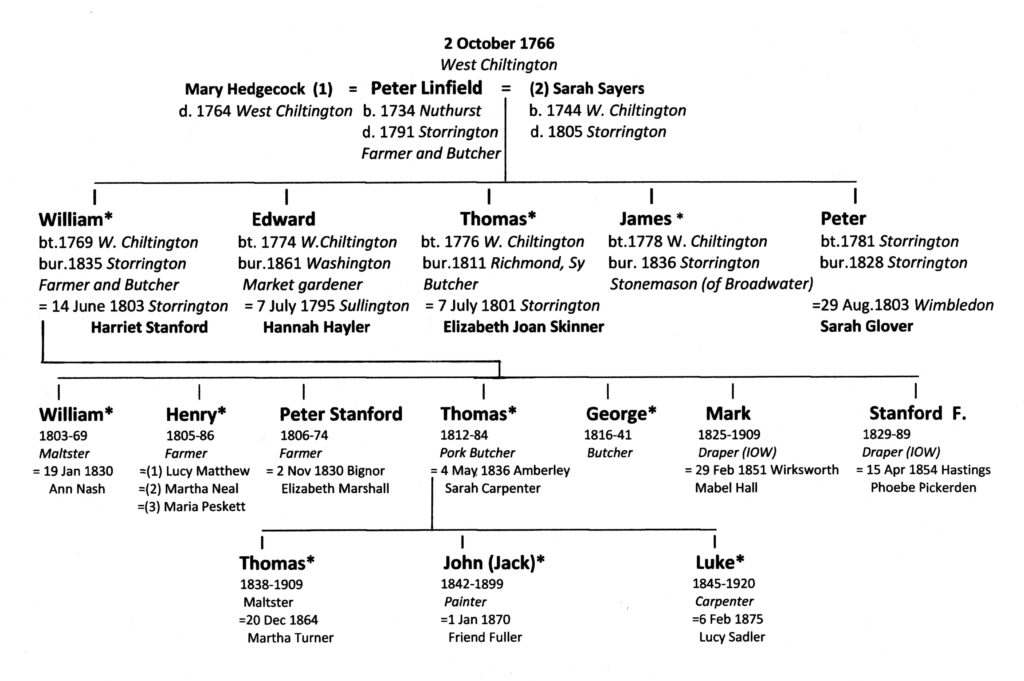
In August 1799, J. Linfield, T. Linfield and W. Linfield appeared in Storrington sides. All three of them seem to be children of Peter and Sarah Linfield, specifically James, Thomas and William. My intention in this article is to show the family relationships between the various Linfield cricketers who played for Storrington.
JAMES LINFIELD (1778-1836)
James was baptised at West Chiltington on 29 December 1778. In July 1796, he was apprenticed to Thomas Hews of Petworth as a stone mason, eventually moving to Broadwater. He appears in the Storrington and Pulborough team which played on Storrington Common on 10 August 1799 against a team from Arundel and Shoreham. His brother William also played. James was bowled out in his first innings, having scored only one run; in his second innings, he was not out, having scored 14 runs. James never married, but after his death in 1836, his body was brought back to Storrington for burial in the churchyard.
THOMAS LINFIELD (1776-1811)
Thomas was baptised at West Chiltington on 19 April 1776, and was the 5th son of Peter and Sarah Linfield. On his first appearance at a cricket match on 29 August 1799 against Broadwater, he scored 4 runs in his first innings and a much better 22 runs in his second before he was bowled out. His older brother William was also a member of the Storrington team.
Thomas also played for Storrington in 1800 in the famous game where the village team achieved a 19-run victory against a strong Sussex side. Advertised as a ‘Grand Cricket Match at Storrington on July 4 and 5, 1800’, Thomas opened the batting for Storrington, although he hardly excelled himself, being bowled out for one run in his first innings and caught after four runs in his second! However, when fielding, he did catch two balls resulting in the dismissal of two Sussex players for a total of 12 runs between them. Thomas must have felt very proud to be a part of this match since winning against Sussex would have been an amazing achievement for the team and the village.
The Storrington team included the legendary player John Hammond, who came to live in Church Steet in 1799. John was a plumber and glazier by profession and moved into the Old Forge, where he had his business premises. The Hammonds were well-known Storrington cricketers, and John played first class cricket himself between 1790 and 1816. He was declared by Alfred Gaston to have been ‘one of the greatest and most successful players that has ever appeared, as he was eminent for his skill in batting, bowling and wicket-keeping’ (Sussex County Magazine, Vol. 1 1927). He played for Sussex and England and at a meeting in June 2024 about the history of Church Street at Storrington Museum, it was recorded on one of the display boards that at a time when
… slow bowling was very common … he (John) speeded up the game by running into the ball. He played first class cricket into his sixtieth year and his son and grandsons happily inherited his great talent. John Hammond is credited with being one of the founders of the Storrington Cricket Club. He died in 1844 aged 73. His tombstone is close to the tower of Storrington Parish Church and can be seen from the path.
John Hammond was one of the leading all-rounders of his time and his prowess at the game of cricket was passed on to the next generations; his son, Charles James Hammond, born in 1818, played first class cricket for Sussex between 1841 and 1849, a superb batsman but not always selected due to his limited fielding ability. His grandson, Ernest Hammond, nephew to Charles, represented Sussex in the 1870s. As landlord of the White Horse Inn in Storrington, he organised local cricketing events, such as the legendary game played on the frozen pond at Chantry Mill in 1891.
On 28 July 1800, various newspapers advertised ‘another grand match to be played near Storrington, by nine gentlemen of that place, with two picked men, against eight gentlemen from the other parts of Sussex, with three picked men’ on 31 July/1 August. Presumably organised as a re-match to test whether the same result could be achieved a second time, Thomas was again selected to play for Storrington, the stakes being set at 100 guineas a side. Gambling played an important role in the adoption of cricket by the local aristocracy and gentry and this helped in the spread and popularity of the game. However, the stakes were much less on minor games between local sides. Oddly, the results of this match were never reported in the local papers which is surprising given its high profile, and leads to the conclusion that it failed to take place and was cancelled at the last moment.
Unfortunately, Thomas’s cricketing feats at Storrington were to end prematurely – after his marriage to Elizabeth Joan Skinner at Storrington on 7 July 1801, the couple went to live at Richmond in Surrey where Thomas worked as a butcher. Their son Ralph Linfield was baptised at Richmond 4 May 1810. Sadly, Thomas died in 1811 at the age of 35. Their grandson was the Rev. Ralph Parkinson Linfield (1843-1912), subject of a previous article in this journal.
WILLIAM LINFIELD (1769-1835)
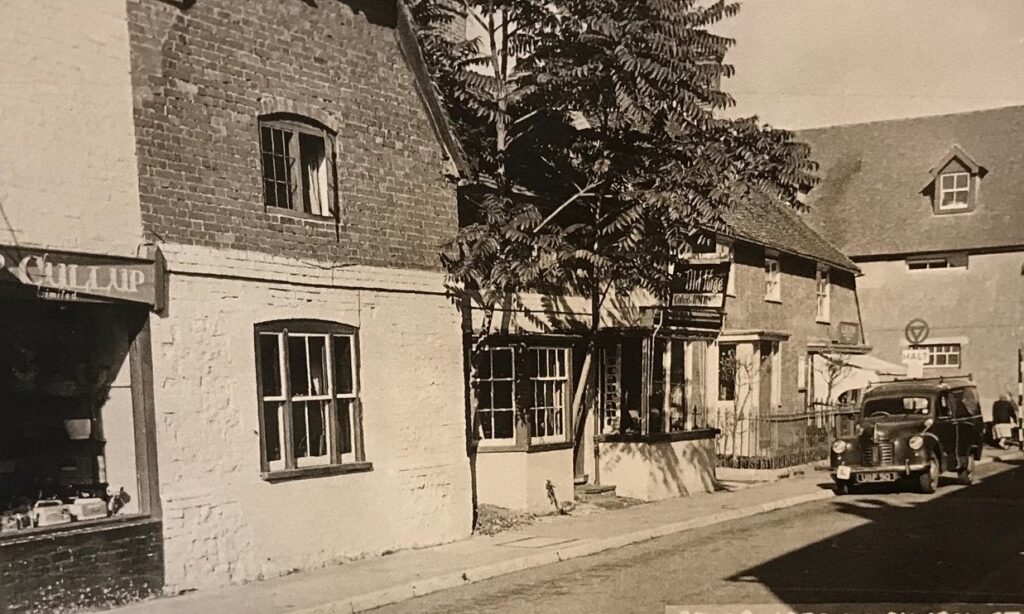
William was the eldest son of Peter and Sarah and worked in his father’s occupation as a farmer and butcher. His widowed mother continued to live at the house until her own death in 1805, so William probably continued to run the butcher’s shop from the same premises, but eventually moved the business to another building in Church Street, which still survives to this day and is currently called ‘Little Boltons’ with the original shop still attached. Incidentally, being next to the Old Forge, William and his family became next door neighbours to the Hammonds. Their shop continued as a butcher’s until as recently as 1972 when it was owned by the Seldon family. It is now the Louisa Austen clothes shop. At the age of 34, William married 19-year-old Harriet Stanford at St. Mary’s Church on 14 June 1803 and they proceeded to have a large family of 13 children between 1803 and 1829, among whom several played cricket.
William himself appeared for the Storrington team on a couple of occasions around the turn of the century, the first on 10 August 1799, with his brother James when they appeared in a Storrington and Pulborough side against a team of Arundel and Shoreham players. The Sussex Weekly Advertiser commented ‘from the several turns the game took, (it) proved unusually interesting to those concerned, and very amusing to the spectators’ (Sussex Weekly Advertiser, 19 Aug 1799) although we have no idea what is being referred to. William was the last batsman in both his innings, scoring zero not out in the first and 7 in the second until bowled out. Storrington and Pulborough won by 2 runs, a very close game.
On 29 August 1799, William was in the Storrington team against Broadwater with brother Thomas, which took place on Storrington Common. His batting was slightly better this time, having scored 17 in his first innings before being run out, and not out with 7 runs during his second. On the field, he managed to catch the ball from a hit by Bridger thereby limiting his runs to just 2. Storrington won by 130 runs.
There was a W. Linfield who played in a Storrington side in 1822. This could have been William, now aged 53, but more likely his eldest son William junior (1803-1869), who would have been about 19 at the time.
THE 2nd GENERATION OF LINFIELD PLAYERS, CHILDREN OF WILLIAM AND HARRIET
THOMAS LINFIELD (1812-84)
In June 1837, a T. Linfield appears in a game. I think this must be Thomas Linfield (1812-84), William and Harriet’s 5th son, and definitely a very keen cricketer throughout his life, starting as a player and then umpiring all over Sussex when he was too old to play. Thomas married Sarah Carpenter at Amberley in 1836, and they had 5 children, three of whom played cricket at various times.
Thomas was also a butcher in Storrington, with premises of his own in Church Street, but he deliberately chose to work as a pork butcher because it would allow him to have his summers free, and he only had to work during the autumn and winter. In those days people did not eat pork in summer; however, devoting himself to cricket also had a consequence for his children because there was nothing to spend on their education and they were turned out to work at the age of twelve.
HENRY LINFIELD (1805-86)
In August 1839, there are three Linfield playing in a match – H, G, and T. Linfield. I am sure the T. refers to Thomas Linfield, now aged 27, mentioned above. H. Linfield has to be Henry Linfield, his older brother, who worked in partnership with his brother William to carry on the family farms which they took over in 1835 when their father William died. Henry lived at Hurston Street Farm which consisted of over 250 acres, but sadly the business failed in 1851 and soon after his insolvency, the family left Storrington and took their young children with them to start a new life. They moved to Lincolnshire where Henry found a job working for one of the railway companies as a gate keeper. William remained in Storrington where he owned a malthouse, although in 1861 he is described in the census as a ‘gardener’.
GEORGE LINFIELD (1816-41)
The G. Linfield referred to in August 1839 must be George Linfield. George was baptised at Storrington on 16 July 1816, the 7th son of William and Harriet Linfield. Interestingly, we know George certainly had an interest in cricket because of his whereabouts on the night of the 1841 census (Sunday, 6 June). He is staying at the Unicorn Inn in North Street, Brighton. His age is given as 25 and his occupation as butcher. The names of his companions and the date are of significance in trying to explain the reason for him being there. The following day, 7 June 1841 was the first day of the Sussex County cricket match against Kent at the Royal New Ground, and his companions are some of the Sussex cricketers selected to play in the team, which included George Millyard, farmer, 25; Mortimer Ewen, farmer, 20; Charles Hawkins, hairdresser, 20; and Charles Hammond, painter, 20. Frederick Haslett, woolstapler, 25 is also there, another Sussex player, although he doesn’t seem to have been selected for this particular match.
Although we know he played a bit himself, there is no evidence suggesting he was there other than to support his friend, Charles Hammond who lived next door to the Linfields in Church Street, where his father John had his business as a plumber, glazier and painter at the Old Forge. George and Charles would have known each other all their lives and as this was a very special occasion for Charles, who was making his first-class debut for Sussex, George was probably there to accompany his friend and give him encouragement and support. No doubt, Charles was grateful to have his friend with him and George was excited to be there to enjoy the game and watch his friend perform.
Unfortunately, Charles had a particularly inauspicious game: scoring just 2 not out during the first Sussex innings and zero before being caught in the second. Kent won by an innings and 16 runs. Charles played first class cricket for 13 years, making a total of forty appearances. Renowned for his big hitting as a batsman, however, he was not the best of fielders which meant he was not always picked for the more important matches.
However, this match was sadly to be one of the last games George ever watched. Only two months later, he died from tuberculosis, that scourge of Victorian Britain which disproportionately affected young adults. He was buried in the churchyard of St. Mary’s, Storrington on 24 August 1841. The inscription on his gravestone near the war memorial can just be deciphered.
WILLIAM LINFIELD (1803-69)
In a match on 19 September 1849, ‘H. Lindfield’ (Henry, as above) and G. Standford, were commended for their admirable fielding, ‘both of whom caught the ball in good style’. In August 1850, Henry Linfield and presumably his older brother William are in a senior players side against juniors. William is recorded in a single wicket match on 8 September 1852, and his younger brother Thomas (b.1812) was in the Sliders Side in the match played on ice on 21 February 1855. During the 1860s, William and his wife Ann decided to leave the village and move to Bexley Heath in Kent, where he died in 1869.
THE 3rd GENERATION OF LINFIELD PLAYERS, CHILDREN OF THOMAS AND SARAH
JOHN (JACK) LINFIELD (1842-1899)
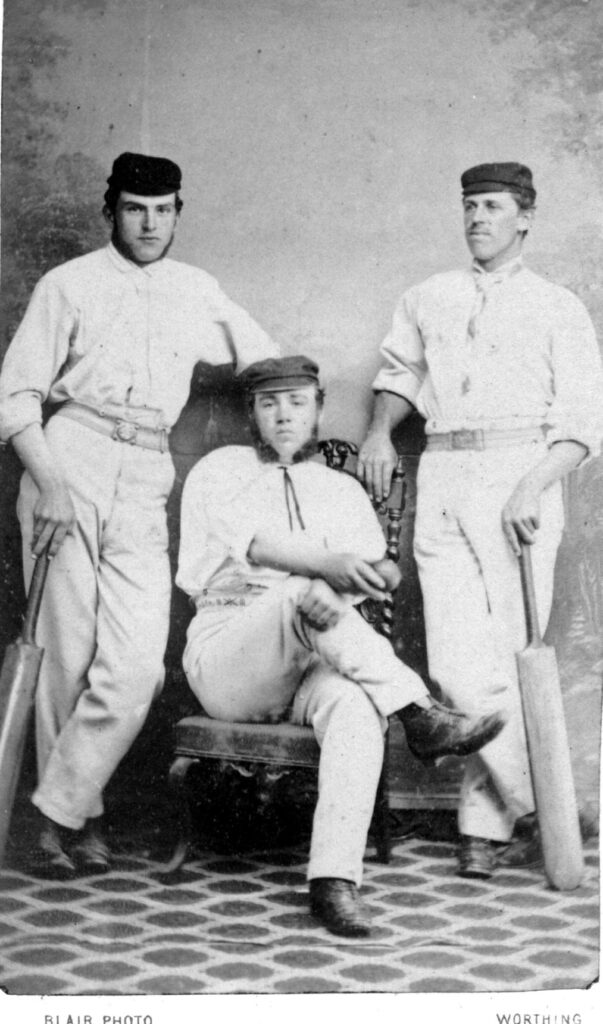
Fig 2: Well-known Storrington cricketers L -R: Ernest Hammond, Harry Crowhurst (seated) and Jack Linfield, c.1870
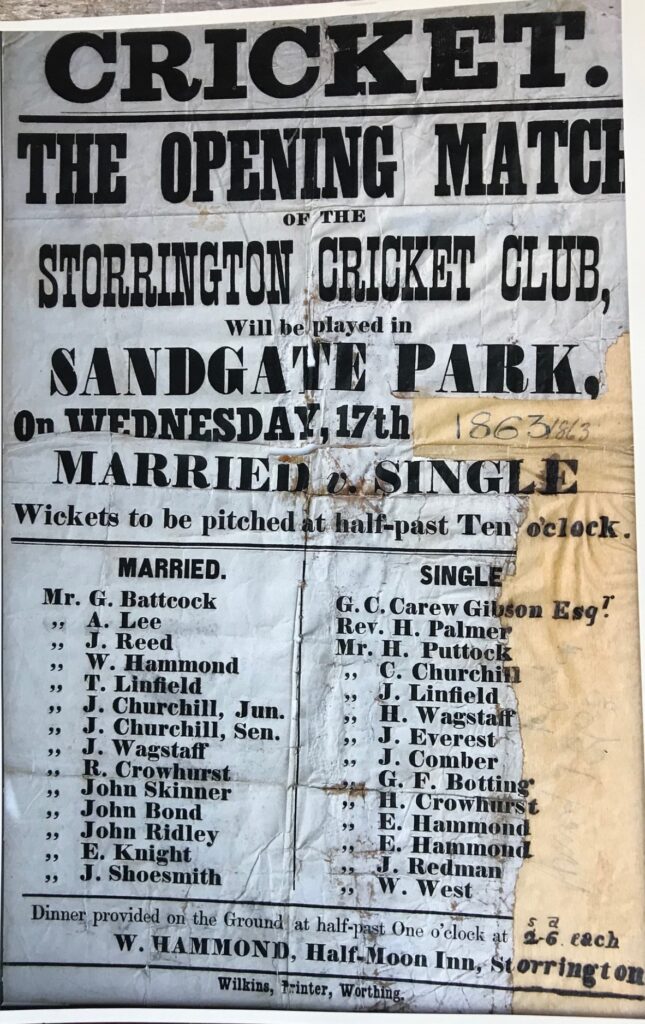
Both John (known as Jack) Linfield and his father Thomas appeared in Single and Married sides in 1861 and 1863. Jack appears to have been the best cricketer in the family, appearing on numerous occasions for the village. Jack was a painter by trade, and in 1870 he married Friend Fuller of Storrington. On 29 August 1864, he played with his father in a Storrington Eleven against Fifteen of mid Sussex. Famously, he captained the team which defeated William Hammond’s XI on 17 January 1867 – the match having taken place on the frozen village pond! His team won by 112 to 89.
Up until the 1890s, Jack appeared on numerous occasions for the club, a competent all-rounder who usually made reasonable scores, bowled well and frequently caught the ball when fielding. On 8 January 1891, Jack refereed another well-known match on ice, this time at the Chantry Mill Pond, where nearly 300 spectators enjoyed an exciting match between teams chosen by his great friends, Harry Crowhurst and Ernest Hammond. The local paper made the observation ‘there was good play shown, although it was decidedly cricket under difficulties’. Sadly, Jack died in 1899 at the early age of 57.
LUKE LINFIELD (1845-1920)
Jack’s younger brother, Luke made his first appearance in a cricket team on 14 July 1863, when he played in a side of 33 for Town and Neighbourhood. He also appeared in a Storrington team with his brother Jack against Henfield in September 1869. He was a carpenter by trade. The brothers also played together in a match at Storrington in 1871 between the ‘gentleman’ of mid-Sussex, a team put together by the Rev. H. Palmer, the rector and including the Hon. Robert Curzon of Parham House. John bowled out four of the mid-Sussex players, including the Rev Palmer. When the Storrington Club were batting, the Rev. Palmer must have felt very satisfied at catching both John and Luke at very low scores (Chichester Express and West Sussex Journal, 11 July 1871 p2).
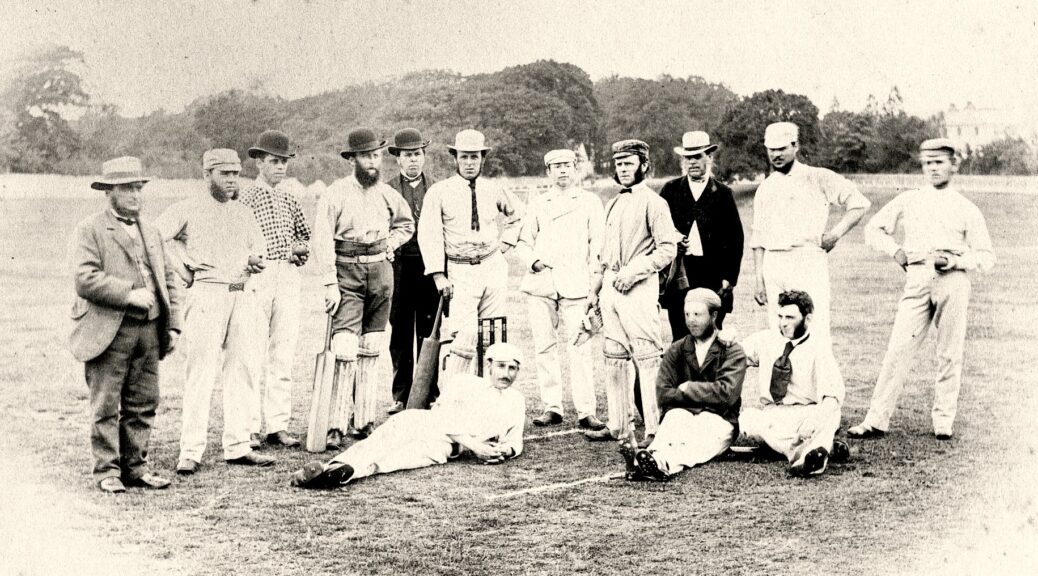
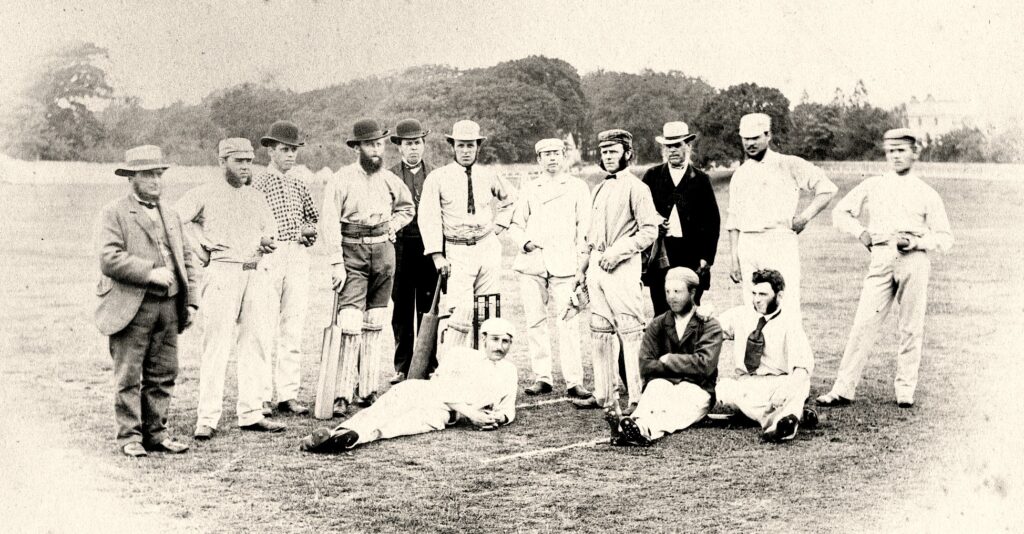
The picture below from the Storrington Museum archive shows a Storrington team at what appears to be Sandgate Park to the east of Storrington. Unfortunately, it is not annotated but a number of cricketers are identifiable by comparing other photos in the archive, which have been named. The building in the background looks very much like Sandgate House, but before it was extensively rebuilt by the Carew-Gibsons in 1867. This helps to date the photo to no later than 1867. I think that Jack Linfield is one of them, third from the left, and the player to his right looks like Harry Crowhurst. Ernest Hammond is not in the picture but one of his relatives is – his brother WH Hammond, standing with his bat behind the wickets. One of the older gentlemen, presumably the umpires, may be Jack’s father, Thomas Linfield who would have been in his fifties at the time.
THOMAS LINFIELD (1838-1909)
The T. Linfield Jnr who appeared in an older player’s side in September 1870 was probably Thomas, eldest son of Thomas Linfield (1812-84) and older brother of Jack and Luke. He would have been 32 in 1870, but it would be interesting to know the qualifying age for the older player’s team. Thomas was a malster in the village.
According to Jack’s daughter Evelyn May (1888-1969), who was the youngest child in a family of nine, her father supplemented his income by snooping on racehorses exercising in gallops on the lush grass of the foothills of the South Downs. He was paid by the Sporting Life and other papers for his services! Incidentally, May celebrated her Golden Wedding to Joe Page in 1963, another Storrington cricket legend in his time. Joe has been immortalised as the character ‘Sid Smith’ in The Cricket Match, a 1924 novel by Hugh de Selincourt. Selincourt had only recently moved to the village and his novel tells the story of a game of cricket in the fictitious village of Tillingfold, based on Storrington. The fact that he also played village cricket and was the leading bowler for Storrington for many years added authenticity to his novel. JM Barrie wrote to Selincourt that he thought his book ‘the best story about cricket or any other game that was ever written’.
The family tree shown below shows the relationship between the several members of the Storrington Linfield family who played at various times for the club (Fig. 5).